

In this week's edition
- ✍️ Letter from P'Fella
Feeling more and more like a community - 🖼️ Image of the Week
Adipofascial flap for salvaging exposed tibia - 🚑 Technique Tip
ALT flap harvest for lower limb trauma - 🎙️ New Podcast Season Coming Soon!
Quick call out for medical illustrators/animators - 📖 What Does the Evidence Say?
Muscle vs fasciocutaneous free flaps in lower-limb open fractures - 🔥 Articles of the Week
Lower limb recon: ALT perforator flaps for sole recon, pedicled perforator flaps, & antibiotics in open fractures. - 💕 Feedback
Suggest ideas & give feedback!
A Letter from P'Fella
Feeling More and More Like a Community
Mostly on calls. Some continued interactions over email. I truly don’t think we expected just how much we’d take away from having conversations with you face-to-face.
There’s something quite different about hearing how people are actually navigating training. The specifics are rarely what you’d predict from the outside.
And more than anything, it’s been genuinely inspiring. In a very real sense, seeing how much people care about getting better, about doing things properly, about helping the next person coming through. You can feel it in the way people talk about cases, teaching, mistakes, and connecting with others who experience similar things.
It’s made something very clear to us. This isn’t just a platform anymore. It’s starting to feel more and more like the community we've been striving to build.
What’s super interesting is that the value isn’t just coming from what we put out, it’s coming from all of you by interacting with us. And the way your ideas, perspectives, and experiences shape what we do next.
That’s the part we want to lean into more.
Because these meaningful ideas come from conversations. The kind where someone explains how they actually approach something, or why they do it a certain way, or what caught them out the first time.
So we’ve been thinking about how to create more space for that.
Last week, we asked you about building a monthly specialised newsletter, similar to this Plastics Paper, but something that allows us to go deeper and bring more of you into the conversation.
Instead of just us writing and publishing, we want it to be more like,
- Sharing thoughts and perspectives from different people
- Highlighting how others approach problems
- Opening up space for discussion
- Helping you build connections with each other along the way
Something that feels like a shared space for learning.
We’re still shaping what this looks like, but the intention is simple: To make this something you’re part of instead of something you just read.
We’ll share more on this soon. We're so excited to speak to more of you in the upcoming weeks and hear your thoughts and ideas.
With love,
P’Fella ❤️
Image of the Week
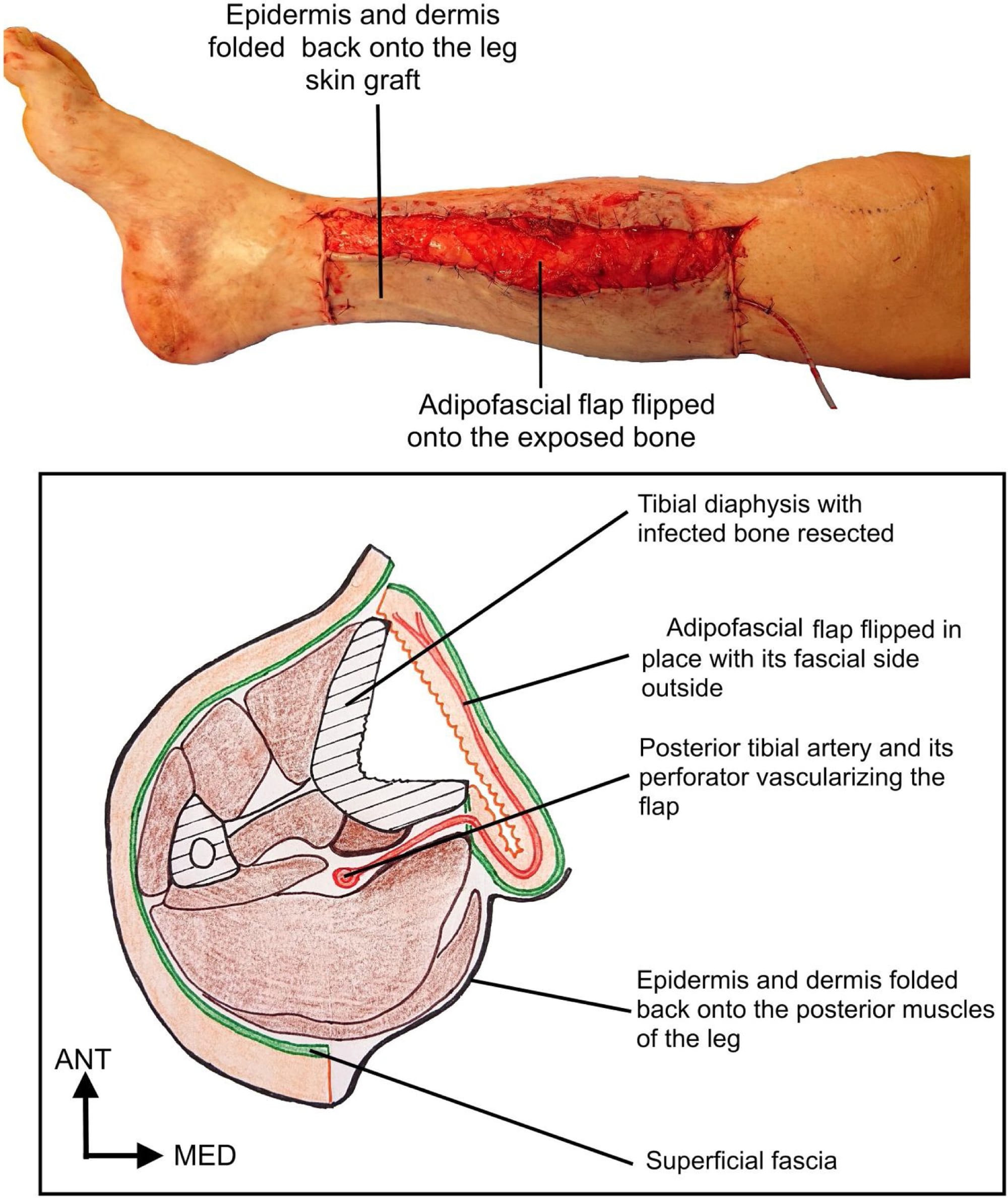
Adipofascial Flap for Salvaging Exposed Tibia
This image demonstrates a local adipofascial flap used to cover exposed tibia following debridement in lower limb trauma.
The flap is raised from the subcutaneous tissue and fascia, based on perforators (here from the posterior tibial system), then flipped onto the exposed bone. The overlying skin is preserved and can be repositioned or grafted, creating a thin, well-vascularised coverage layer.
In open fractures, exposed bone will not heal without soft tissue coverage. This technique highlights a key reconstructive principle:
👉 Well-vascularised tissue is essential for bone healing and infection control.
Adipofascial flaps offer a local, reliable option for selected defects, avoiding the need for free tissue transfer while still achieving durable coverage.
Technique Tip
ALT Flap Harvest for Lower Limb Trauma
This video demonstrates anterolateral thigh (ALT) flap harvest, a workhorse technique for reconstruction of complex lower limb defects. The flap is based on perforators from the descending branch of the lateral circumflex femoral artery, which are often musculocutaneous and require careful intramuscular dissection through vastus lateralis to isolate the pedicle.
The key technical principle is meticulous perforator dissection and preservation. Identifying a reliable perforator early and dissecting it safely through muscle is critical to avoid injury and ensure flap viability. With a long pedicle, large skin paddle, and ability to include muscle if needed, the ALT flap provides versatile, reliable coverage for open fractures and exposed structures in lower limb trauma.
New Podcast Season Coming Soon
Quick Call Out for Medical Illustrators/Animators
As we prepare for the launch, we’re looking for a medical illustrator/animator to help bring the visuals to life.
We’ve worked with general editors before, but what’s been missing is someone who truly understands medical and surgical concepts to translate complex ideas into simple, engaging visuals.
If you’re someone (or know someone) who:
- Has experience in medical illustration or animation
- Understands clinical/surgical language and concepts
- Can create clean, high-quality graphics/animation
We’d love to hear from you!
What Does the Evidence Say?
Muscle vs Fasciocutaneous Free Flaps in Lower-Limb Open Fractures
The main nuance is bone healing. In acute Gustilo IIIB tibial fractures, retrospective radiographic data suggest muscle flaps may accelerate early healing, with faster radiographic progression in the first 6 months and more fractures united by 6 months. So the current evidence supports a defect-driven approach rather than dogma: muscle flaps remain attractive when you need bulk and dead-space obliteration, while fasciocutaneous flaps are very competitive overall and appear to offer lower donor-site morbidity and lower partial-failure risk.
The bottom line is that the comparative literature is still retrospective, so flap choice should be tailored to the wound, the bone problem, and the reconstructive plan.
Sources: (Khouri, 1989); (Cho, 2018); (Mehta, 2018); (Dow, 2023); (Mégevand, 2022)
Articles of the Week
3 Interesting Articles with One-Sentence Summaries
The ideal plantar reconstruction needs to balance durability, contour, and sensation, and ALT perforator flaps can be thinned to 4-6 mm while still supporting long-term weight bearing and sensory recovery.
Pedicled perforator flaps can cover up to 75% of the lower leg surface area, offering a powerful alternative to free flaps with good reliability and versatility.
Early antibiotics (typically gram-positive cover like first-gen cephalosporins) given at initial management reduce infection risk by ~57% (RR 0.43; ARR ~7%).
