


Tip refinement is considered for disproportionate width, poor definition, malrotation, malprojection, asymmetry, or tip support problems, but the plan should be modified or declined when skin, anatomy, airway risk, scarring, or expectations make a stable natural result unlikely.
Applied Anatomy
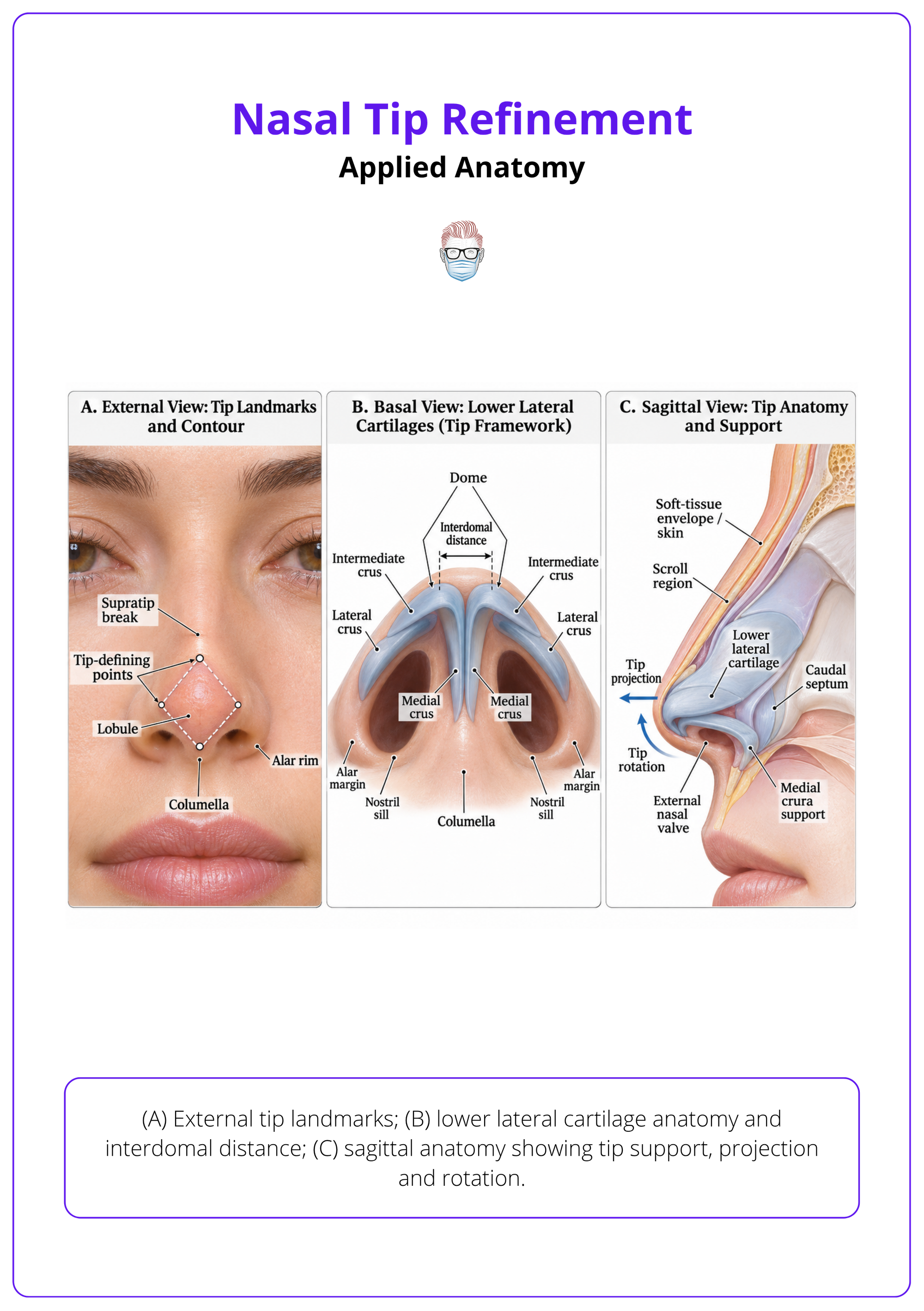
Tip refinement depends on the lower lateral cartilages, domes, interdomal distance, soft-tissue envelope, scroll region, ligaments, vascular supply, and valve-support relationships.
Assessment and Planning
Assess the patient’s goals, skin envelope, lower lateral cartilage shape, projection, rotation, symmetry, support, airway, photographs, and measurable baseline before choosing a refinement strategy.
Technique Selection
Choose the least destructive technique that corrects the dominant deformity while preserving support, airway function, skin drape, and long-term contour.
Operative Principles
Safe tip refinement exposes the framework, preserves support, modifies cartilage conservatively, places sutures deliberately, fixes grafts securely, and checks symmetry and airway before closure.
Complications
Early problems include bleeding, infection, skin compromise, and airway obstruction; late problems include asymmetry, bossae, retraction, pinching, malrotation, graft visibility, under-projection, and revision need.
Postoperative Care
Postoperative care protects the new framework, controls oedema, monitors skin and airway, and escalates bleeding, infection, skin compromise, or worsening obstruction early.
Outcomes and Counselling
Tip refinement usually gives gradual, anatomy-limited improvement in definition, projection, rotation, and symmetry, with final judgement delayed until swelling and scar maturation settle.
Indications and Suitability
Tip refinement is considered for disproportionate width, poor definition, malrotation, malprojection, asymmetry, or tip support problems, but the plan should be modified or declined when skin, anatomy, airway risk, scarring, or expectations make a stable natural result unlikely.
Tip refinement changes the cartilaginous framework and how the skin envelope drapes over it. It does not reliably “shrink” thick skin, erase all asymmetry, or correct unrelated dorsal, septal, chin, or facial imbalance.
1. Offer refinement when the deformity matches the manoeuvre
The best indication is a visible tip problem with a correctable anatomical cause.
- Bulbous tip: broad domes, wide interdomal distance, thick soft tissue, or weak definition.
- Boxy tip: squared-off dome geometry or excessive lateral crural width.
- Drooping tip: inadequate support, long caudal septum, or poor rotation.
- Asymmetric tip: unequal domes, crural shape, septal deviation, or previous surgery.
2. Modify the plan when the envelope limits definition
Skin thickness often determines how much refinement the patient will see.
- Thick sebaceous skin: definition is harder to achieve and oedema may resolve more slowly 1.
- Thin skin: definition may show well, but graft edges and suture irregularities are less forgiving.
- Interdomal suture alone: a poor choice when thick skin or excess subcutaneous tissue will blunt the effect 2.
- Ethnic rhinoplasty: plan around the patient’s anatomy and aesthetic goals, not a single idealised tip shape 3.
3. Decline unsafe or unrealistic refinement
A conservative operation is better than an over-resected, pinched, unstable tip.
- Modest deformity: choose conservative tip-refinement manoeuvres before aggressive cartilage reduction 4.
- Wide tip: consider suturing and structural grafting rather than excision alone 5.
- Anterior tightening: avoid plans that risk skin pinching or caudal tip rotation from poorly controlled anterior suture placement 2.
- Complex deformity: cleft or heavily scarred secondary tips need counselling that refinement is technically difficult 6.
Applied Anatomy
Tip refinement depends on the lower lateral cartilages, domes, interdomal distance, soft-tissue envelope, scroll region, ligaments, vascular supply, and valve-support relationships.
The nasal tip is a three-dimensional structure. Small changes in cartilage shape, suture vector, or graft position can alter projection, rotation, definition, nostril shape, and airway.
Read the lower lateral cartilage before reshaping it
The lower lateral cartilage is the main framework for tip contour.
- Domes: the key cartilage target for interdomal suture refinement 2.
- Medial crura: contribute to columellar support and tip projection.
- Lateral crura: influence alar contour, external valve support, and pinching risk.
- Tip geometry: interdomal distance, domal width, cartilage strength, and skin type guide manoeuvre choice 2.
Preserve support at the hinge and scroll areas
Tip refinement fails when narrowing sacrifices the structures that hold the airway and contour.
- Nasal hinge: plan hinge manoeuvres around the most lateral lower lateral cartilage 7.
- Scroll area: disruption can destabilise the internal valve relationship.
- Alar rim: weak or malpositioned lateral crura can cause retraction, notching, or collapse.
- Residual strip: preserve enough cartilage to resist scar contracture and late distortion.
Treat the soft tissue as part of the anatomy
The same cartilage manoeuvre looks different under thin, thick, scarred, or ageing skin.
- Skin envelope: thickness and sebaceous quality affect definition and swelling.
- Ageing nose: soft-tissue atrophy, tip ptosis, and valve collapse can affect both appearance and airflow 8.
- Contour analysis: assess cartilage straightness, lateral crural eversion, caudal-cephalic edge relationship, and diamond-shaped tip contour 9.
- Scarred cleft tip: pre-existing deformity and scarring increase operative difficulty 6.
Assessment and Planning
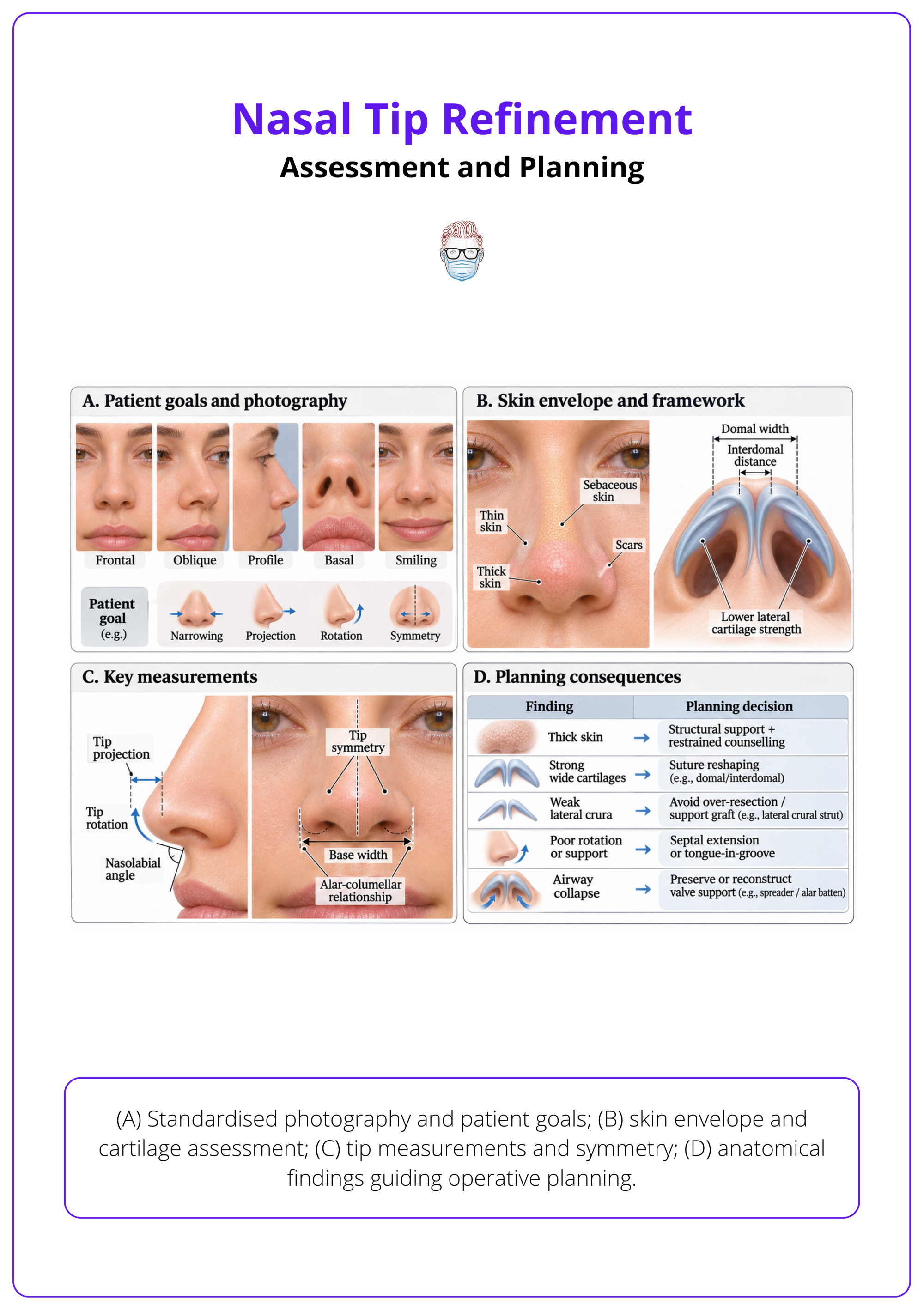
Assess the patient’s goals, skin envelope, lower lateral cartilage shape, projection, rotation, symmetry, support, airway, photographs, and measurable baseline before choosing a refinement strategy.
Assessment should identify the cause of the tip shape, not simply label it as “bulbous.” The operative plan follows the anatomy.
Start with the problem the patient actually wants solved
The consultation should separate tip concerns from whole-nose or facial imbalance.
- Aesthetic goal: define whether the patient wants narrowing, rotation, projection, definition, or symmetry.
- Functional symptoms: ask about obstruction, collapse, trauma, allergy, previous septal surgery, and nasal sprays.
- Psychological suitability: defer surgery for unstable expectations, fixation on perfection, or untreated body dysmorphic concern.
- Revision history: previous grafts, sutures, infection, or scarring change the risk profile.
Examine the tip as a framework under an envelope
A structured analysis prevents choosing a manoeuvre that treats the wrong cause.
- Skin inspection: assess thickness, sebaceous quality, scars, acne, and redness.
- Cartilage palpation: estimate lower lateral cartilage strength, convexity, malposition, and resilience.
- Tip measurements: record projection, rotation, nasolabial angle, alar-columellar relationship, and base width.
- Hinge behaviour: assess whether modifying the nasal hinge could change projection, rotation, or lobule refinement 7.
Find the cause of asymmetry before correcting it
Tip asymmetry is a diagnosis, not a technique choice.
- Domal height: compare dome position, definition points, and supratip break.
- Crural shape: look for concavity, convexity, malposition, or buckling.
- Septal influence: caudal septal deviation can drive tip and columellar asymmetry.
- Planning rule: identify the anatomical cause before selecting corrective manoeuvres 11.
Document the baseline and the decision consequence
Planning should end with a clear operative decision, not a long descriptive analysis.
| Assessment finding | Decision consequence |
|---|---|
| Thick skin, weak definition | Structural support and restrained counselling |
| Strong wide cartilages | Suture reshaping with conservative trimming |
| Weak lateral crura | Avoid over-resection; consider support grafting |
| Poor rotation or support | Consider septal extension or tongue-in-groove |
| Airway collapse | Preserve or reconstruct valve support |
- Photography: take standardised frontal, lateral, oblique, basal, and smiling views.
- Objective measures: anthropometric measurements and patient-reported outcomes can supplement assessment 12.
- Medication planning: isotretinoin protocols remain unsettled, so perioperative use should be individualised 1.
- Early outcome interpretation: splint type can influence early oedema scores, so do not judge refinement too soon 13.
Technique Selection
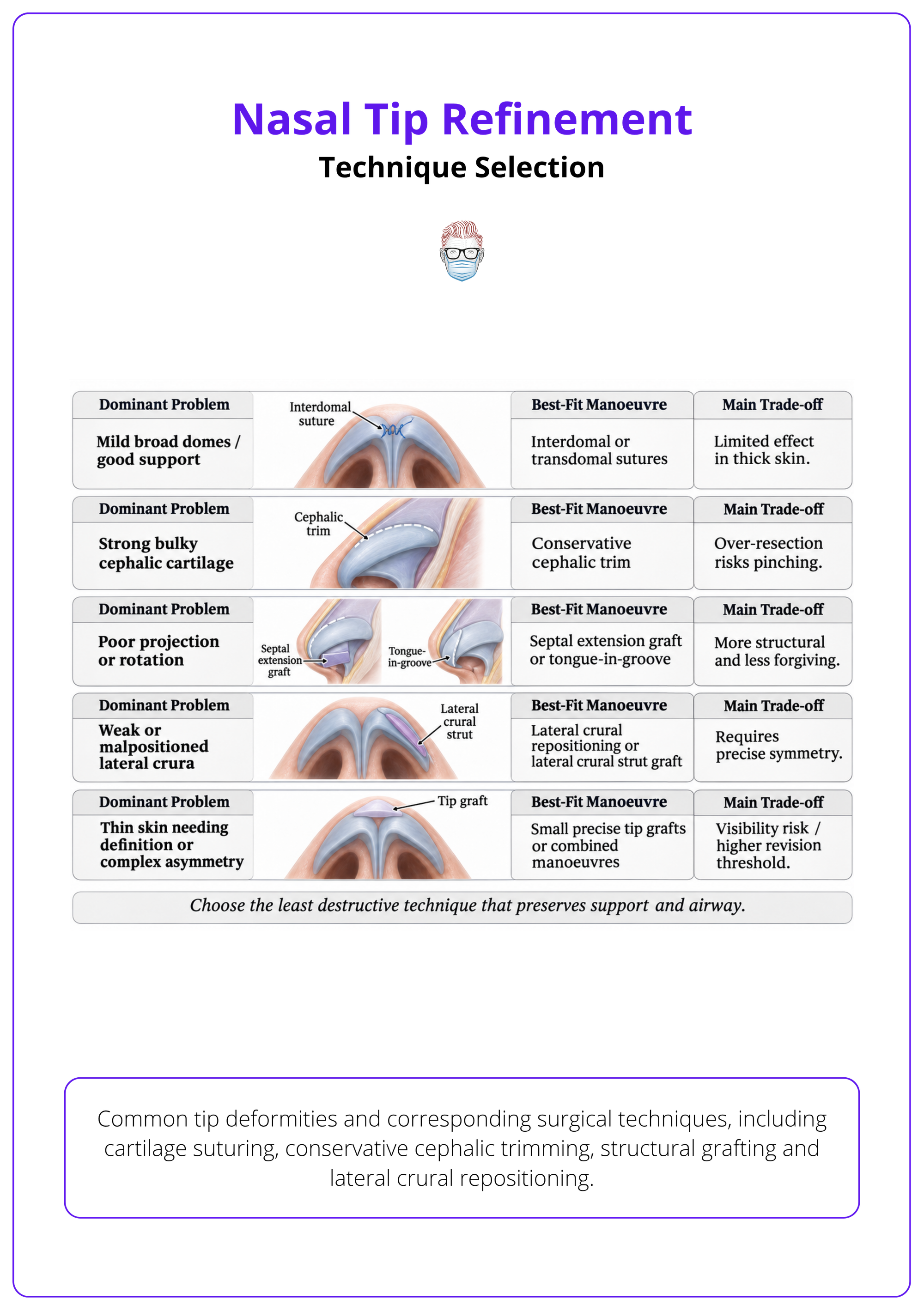
Choose the least destructive technique that corrects the dominant deformity while preserving support, airway function, skin drape, and long-term contour.
Technique selection is not a menu of favourite manoeuvres. It is a sequence: define the deformity, estimate support, judge skin response, then choose sutures, cartilage modification, grafting, or repositioning.
Match the manoeuvre to the dominant deformity
Sutures refine shape; grafts add support or definition; repositioning corrects malposition.
| Dominant problem | Best-fit option | Main trade-off |
|---|---|---|
| Mild broad domes, good support | Interdomal or transdomal sutures | Limited effect in thick skin |
| Strong bulky cephalic cartilage | Conservative cephalic trim | Over-resection risks pinching |
| Poor projection or rotation | Septal extension graft or tongue-in-groove | More structural and less forgiving |
| Weak or malpositioned lateral crura | Lateral crural repositioning or strut graft | Requires accurate symmetry |
| Thin skin needing definition | Small precise grafts | Visibility risk |
| Complex asymmetry | Combined manoeuvres | Higher revision threshold |
- Type I tip: one algorithm selects interdomal suture alone 2.
- Type II tip: the same algorithm adds lower lateral cartilage weakening 2.
- Type III tip: it adds cephalic lower lateral cartilage removal 2.
Use sutures for shape, not for brute-force narrowing
Suture techniques work best when cartilage strength and skin thickness allow the change to show.
- Interdomal suture: narrows dome spacing and improves definition.
- Transdomal suture: refines each dome and can create sharper defining points.
- Lateral crural steal: can increase projection and alter rotation.
- Anterior placement: control carefully because it can cause skin pinching and caudal rotation 2.
Add structure when support or durability is the problem
A refined but unsupported tip will relapse, droop, or obstruct.
- Septal extension graft: useful when projection, rotation, and stability must be controlled.
- Tongue-in-groove: useful for setting medial crura against the caudal septum.
- Tip grafts: may modify dome-defining points, tip point, projection, definition, volume, size, and shape 14.
- Support principle: manoeuvres should preserve natural tip support rather than relying only on reduction 15.
Choose the approach that gives the exposure required
Closed and open approaches are both valid when matched to the task.
- Closed approach: suits selected minor refinement with good symmetry and limited grafting.
- Open approach: suits asymmetry, graft fixation, revision, cleft deformity, or major support work.
- Combined techniques: open suture work may be paired with refinement grafts for consistent shaping 14.
- Cleft or revision tip: technique must be individualised because deformity patterns vary widely 6.
Operative Principles
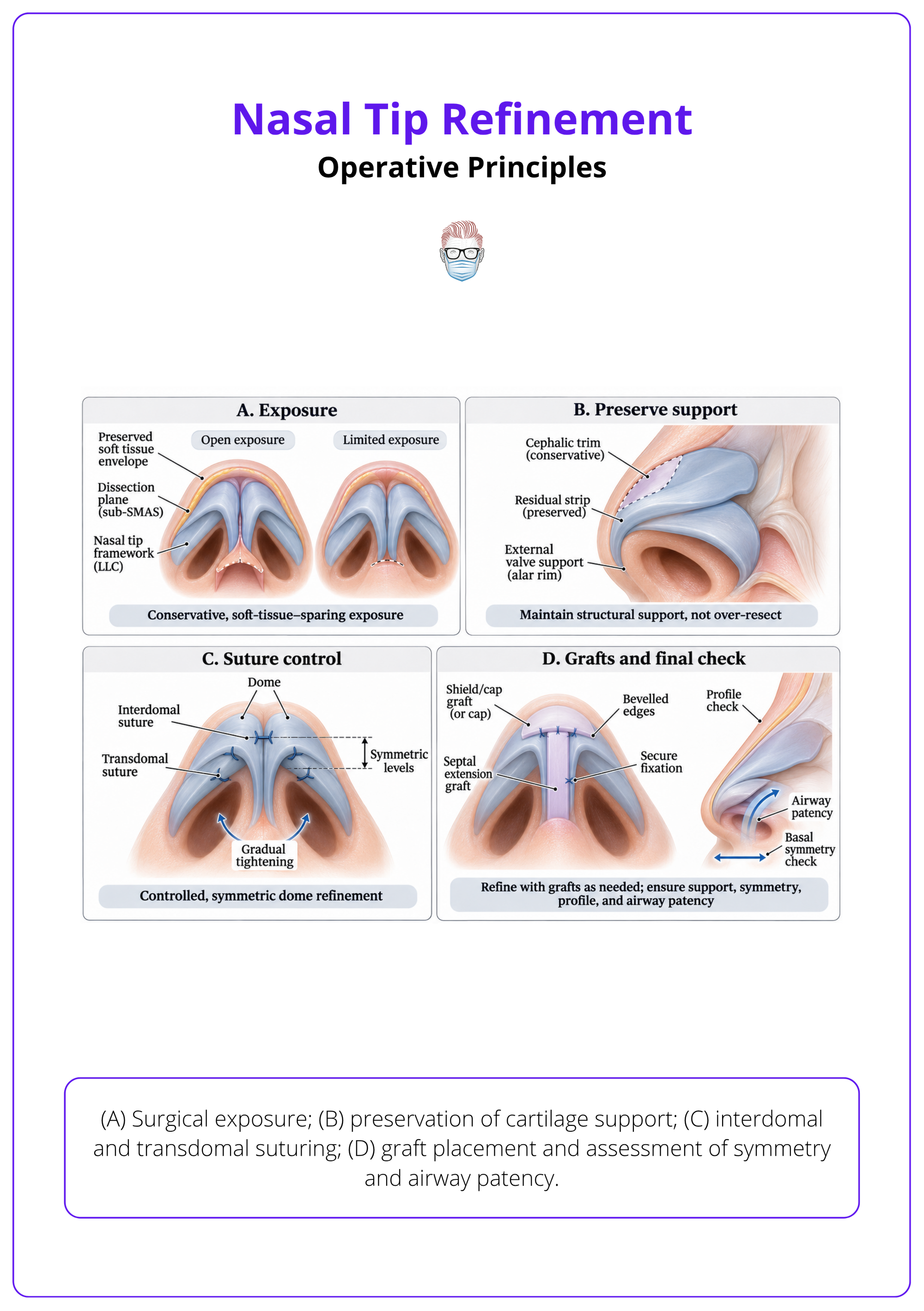
Safe tip refinement exposes the framework, preserves support, modifies cartilage conservatively, places sutures deliberately, fixes grafts securely, and checks symmetry and airway before closure.
The operation should create a stable framework that the skin can drape over. Over-resection, over-tightening, and unstable graft fixation create many late problems.
1. Expose only as much as the deformity requires
Access should give control without unnecessary soft-tissue trauma.
- Open exposure: elevate in the correct plane and preserve vascular soft tissue over the tip.
- Closed exposure: maintain orientation because small asymmetries are harder to see.
- Ageing tip: modify technique for soft-tissue atrophy, ptosis, and valve weakness rather than using a standard plan 8.
- Revision tissue: expect scarring, altered planes, and uncertain graft material.
2. Preserve the support before refining the shape
Reduction without support produces an operated-looking tip.
- Residual strip: keep a complete undivided strip when feasible to improve long-term control 4.
- Cephalic trim: leave enough lateral crus to support the alar rim.
- Natural contour: avoid relying only on reductive techniques when long-term natural shape is the priority 5.
- Support check: assess external valve stability after each narrowing manoeuvre.
3. Place sutures deliberately and tighten gradually
Sutures should reshape the cartilage, not strangulate it.
- Placement point: suture location changes the amount of tip definition achieved 2.
- Progressive tightening: tighten interdomal sutures gradually to titrate definition 2.
- Timing: some authors place the interdomal suture late to reduce manipulation and avoid widening the interdomal distance 2.
- Failure point: mismatched suture levels create asymmetry and bossae.
4. Fix grafts to a stable recipient framework
Grafts fail when they are visible, mobile, asymmetric, or unsupported.
- Septal extension graft: secure to stable septum and check midline projection.
- Shield or cap graft: bevel edges, avoid excessive bulk, and test skin redraping.
- Lateral crural grafting: restore smooth alar contour and avoid valve narrowing.
- Asymmetry: correction may require more than one manoeuvre rather than a single standard technique 11.
5. Check the result dynamically before closure
The last intraoperative check should test appearance and function.
- Basal view: compare nostril shape, dome position, and columellar-lobular balance.
- Profile view: confirm projection, rotation, supratip break, and alar-columellar show.
- Airway: inspect valve patency and avoid new lateral wall collapse.
- Algorithmic narrowing: a structured approach may improve reproducible domal narrowing while preserving lateral alar contour 5.
Complications
Early problems include bleeding, infection, skin compromise, and airway obstruction; late problems include asymmetry, bossae, retraction, pinching, malrotation, graft visibility, under-projection, and revision need.
Complications should be grouped by urgency. Airway compromise, skin vascular compromise, and infection require earlier action than minor swelling or expected asymmetry.
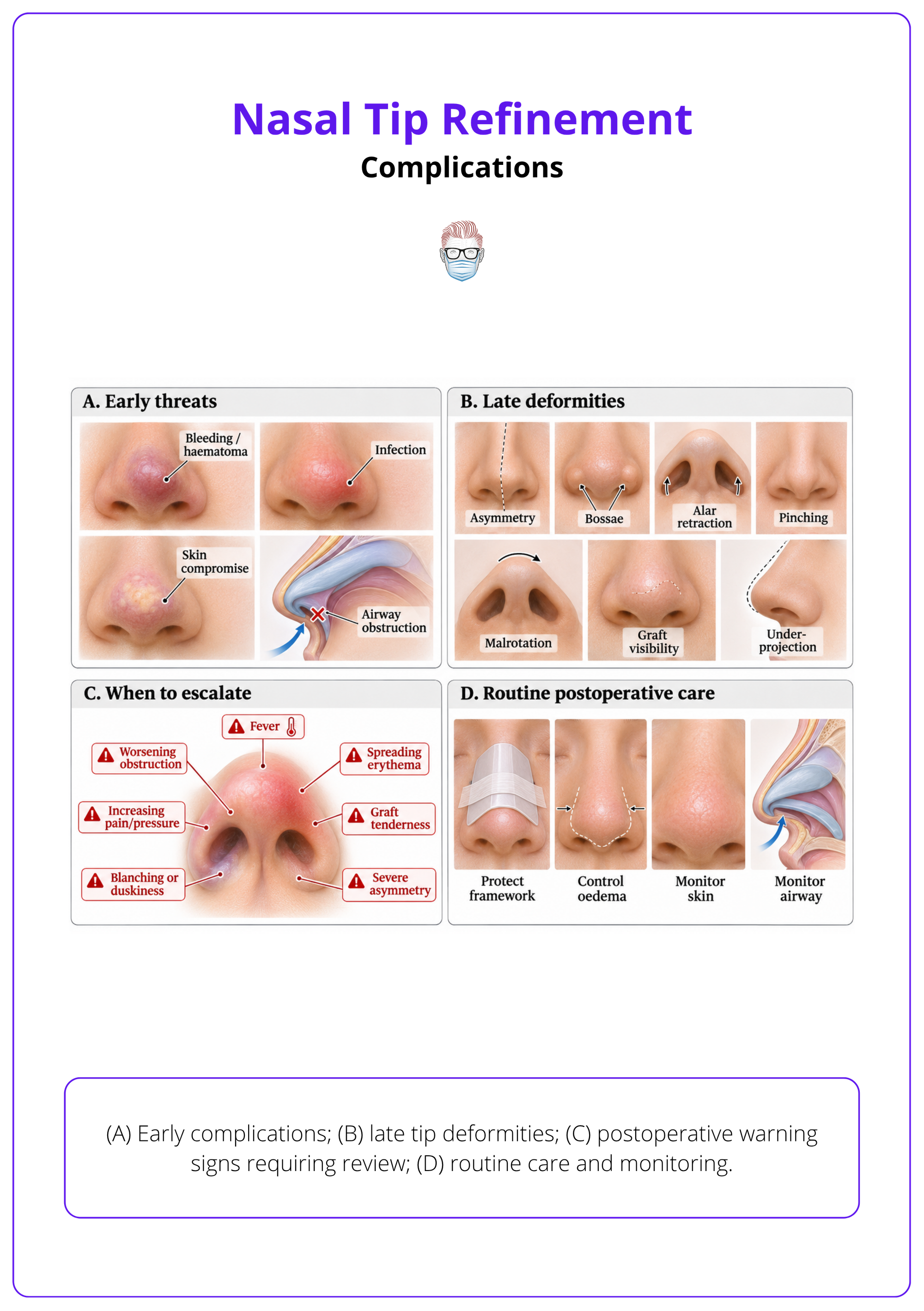
Recognise early threats before they scar
Early review should look for problems that can damage skin, cartilage, or airway.
- Bleeding or haematoma: assess increasing pain, pressure, bruising, or expanding swelling.
- Infection: treat spreading erythema, purulence, fever, or focal graft tenderness promptly.
- Skin compromise: blanching, duskiness, or pressure from splints, tapes, or graft edges needs urgent correction.
- Cellulitis: recurrent tip cellulitis has been reported and may resolve after suture removal 2.
Diagnose the anatomical cause of late deformity
Late deformity is usually a framework problem revealed by scar contraction.
- Asymmetry: mismatched suture levels can produce tip asymmetry 2.
- Bossae: cartilage buckling or sharp suture-related contour can show through thin skin.
- Pinching: anterior suture placement can cause skin pinching and caudal rotation 2.
- Lobular excision: long-term contour after excisional lobular width reduction can be unpredictable and stigmatic 15.
Escalate revision only when the problem is stable
Revision planning should wait until swelling and scar maturation allow reliable diagnosis unless function or skin is threatened.
- Airway obstruction: assess internal and external valve collapse, septal deviation, and alar support.
- Alar retraction: consider cartilage loss, scar contracture, and lateral crural malposition.
- Projection failure: look for weak medial crura, unstable grafts, or inadequate septal support.
- Persistent asymmetry: revision may require several techniques rather than one standard manoeuvre 11.
Postoperative Care
Postoperative care protects the new framework, controls oedema, monitors skin and airway, and escalates bleeding, infection, skin compromise, or worsening obstruction early.
Tip swelling is expected, but progressive pain, pressure, colour change, fever, or unilateral obstruction is not. The trainee’s job is to distinguish normal oedema from a complication.
Protect the framework while swelling settles
Dressings should support the surgical plan without compressing skin or compromising the airway.
- Splint choice: external splinting may be omitted when no osteotomy is performed or osteotomies are stable 16.
- Patch or mould: some regimens remove an external nasal patch and mould after day seven 2.
- Taping: after splint removal, taping can compress the skin envelope and reduce oedema 17.
- Thick skin: taping is especially relevant when skin draping limits refinement 17.
Monitor airway, skin, and infection at each review
Follow-up should focus on function as well as appearance.
- Airway check: ask about new obstruction and inspect the internal and external valves.
- Skin check: look for pressure injury, graft visibility, erythema, or threatened breakdown.
- Oedema control: taping reduced mean nasal skin thickness in a randomized postoperative trial 17.
- Escalation: urgent review is needed for bleeding, fever, spreading cellulitis, skin duskiness, or severe obstruction.
Outcomes and Counselling
Tip refinement usually gives gradual, anatomy-limited improvement in definition, projection, rotation, and symmetry, with final judgement delayed until swelling and scar maturation settle.
Counselling should be practical. The patient should understand what the operation can improve, what their skin and cartilage will limit, and why revision is sometimes needed.
Counsel in shape change, not perfection
A good result is a natural, stable tip that fits the face and maintains airflow.
- Refinement goals: grafting may alter dome-defining points, tip point, projection, definition, volume, size, and shape 14.
- Suture refinement: interdomal suture can improve Caucasian tip definition through a closed non-delivery approach 2.
- Predictability claim: interdomal refinement is described as controllable and predictable, but this comes from expert technique reporting 2.
- Asymmetry: small residual asymmetry is normal because cartilage, skin, and scar forces are not perfectly symmetric.
Set expectations for swelling and skin thickness
The skin envelope often determines when the result becomes visible.
- Thick skin: definition appears slowly and may remain softer than the framework suggests.
- Taping: postoperative taping reduced overall oedema measures but did not significantly change tip thickness in one trial 17.
- Thin skin: taping did not show benefit in a randomized trial of thin-skinned patients 17.
- Isotretinoin: dosing and timing remain unsettled, so it should not be presented as a fixed standard 1.
Discuss durability, trade-offs, and revision
Long-term shape depends on stable support, controlled scarring, and realistic tissue behaviour.
- Support durability: stable graft fixation and preserved lateral crura reduce relapse risk.
- Over-tightening: anterior suture placement can lead to pinching or caudal rotation, so narrowing has limits 2.
- Technique mix: in one female rhinoplasty series, sutured tip plus refinement grafts were used more often than sutures alone 14.
- Cleft rhinoplasty: goals include symmetry, base and tip definition, airway correction, and scar or web repair 6.
Use patient-reported outcomes
Satisfaction depends on expectation, airway, swelling, and whether the new tip matches the face.
- Early satisfaction: in one thick-skinned RCT, isotretinoin improved early excellent satisfaction rates at 3 and 6 months, but not significantly at 12 months 1.
- Skin response: isotretinoin in acne patients reduced measured nasal-tip dermis thickness over 4 months 1.
- Evidence limits: secondary cleft rhinoplasty patients should be told that procedure-specific outcomes evidence is limited 6.
- Revision framing: revision is considered for stable deformity, functional obstruction, graft problems, or unacceptable asymmetry after maturation.
References
[1] Ghazizadeh et al.. Optimizing Rhinoplasty Outcomes: The Role of Isotretinoin and Patient Management Strategies: Systematic Review\.. Journal of cosmetic dermatology. 2025. doi:10.1111/jocd.70575
[2] Mocelin et al.. Nose tip refinement using interdomal suture in caucasian nose.. International archives of otorhinolaryngology. 2012. doi:10.7162/S1809-97772012000300015
[3] Cobo. Ethnic rhinoplasty.. HNO. 2018. doi:10.1007/s00106-017-0452-7
[4] Tardy. Graduated sculpture refinement of the nasal tip.. Facial plastic surgery clinics of North America. 2004. doi:10.1016/S1064-7406(03)00096-8
[5] Dhir et al.. Reshaping of the Broad and Bulbous Nasal Tip.. Clinics in plastic surgery. 2016. doi:10.1016/j.cps.2015.09.013
[6] Pawar et al.. Secondary cleft rhinoplasty.. JAMA facial plastic surgery. 2014. doi:10.1001/jamafacial.2013.1562
[7] Adamson et al.. The nasal hinge.. Otolaryngology--head and neck surgery : official journal of American Academy of Otolaryngology-Head and Neck Surgery. 1994. doi:10.1177/01945998941113P110
[8] Khetpal et al.. Rhinoplasty in the Older Adult.. Aesthetic surgery journal. 2021. doi:10.1093/asj/sjab140
[9] Savetsky et al.. The Alar Equalization Suture for Nasal Tip Refinement.. Plastic and reconstructive surgery. 2022. doi:10.1097/PRS.0000000000009459
[10] Sieber et al.. Finesse in Nasal Tip Refinement.. Plastic and reconstructive surgery. 2017. doi:10.1097/PRS.0000000000003566
[11] Stephan et al.. Asymmetric nasal tip.. Facial plastic surgery : FPS. 2012. doi:10.1055/s-0032-1309297
[12] Skochdopole et al.. Current Surgical Outcomes of Nasal Tip Grafts in Rhinoplasty: A Systematic Review\.. Plastic and reconstructive surgery. 2023. doi:10.1097/PRS.0000000000010257
[13] Erdogan et al.. The Effect of 3D-Printed Custom External Nasal Splint on Edema and Ecchymosis After Rhinoplasty.. Journal of oral and maxillofacial surgery : official journal of the American Association of Oral and Maxillofacial Surgeons. 2021. doi:10.1016/j.joms.2021.02.027
[14] Daniel. Tip Refinement Grafts: The Designer Tip.. Aesthetic surgery journal. 2009. doi:10.1016/j.asj.2009.09.013
[15] Davis. Lateral crural tensioning for refinement of the wide and underprojected nasal tip: rethinking the lateral crural steal.. Facial plastic surgery clinics of North America. 2015. doi:10.1016/j.fsc.2014.09.003
[16] Cabbarzade et al.. External Splinting Is Not Mandatory After All Rhinoplasties: A Prospective Randomized Trial.. Annals of plastic surgery. 2021. doi:10.1097/SAP.0000000000002710
[17] Ozucer et al.. Effect of Postrhinoplasty Taping on Postoperative Edema and Nasal Draping: A Randomized Clinical Trial.. JAMA facial plastic surgery. 2016. doi:10.1001/jamafacial.2015.1944
