


In This Edition
- The Overview: Why facelift surgery is about more than tissue elevation.
- The Case: A patient seeking natural, long-lasting facial rejuvenation.
- The Plan: From the patient's concerns to surgical planning.
- Hot Topics: Three questions shaping modern facelift surgery.
- Take it to the Clinic: From the face to the surgical plan.
- The Evidence: Three papers worth reading.
Welcome to our second edition of Aesthetic Decisions: our first standalone monthly newsletter from the Aesthetic Department.
This month, we're moving deeper into facial anatomy, looking at the SMAS, retaining ligaments, and an increasingly important question in modern facelift surgery: what should we release, and what should we preserve?
Overview
The Role of Facial Retaining Ligaments and Limited Delamination in Modern Facelift Surgery
- Beyond the SMAS: Understanding the facial layers, glideplanes, and supporting structures that guide tissue repositioning.
- Release versus preservation: Why more extensive dissection is not always the answer, and why inadequate release may also limit correction.
- Limited delamination: Exploring how preserving selected tissue attachments may influence flap biomechanics and vascular integrity.
- No single ideal technique: Matching the surgical approach to the patient's anatomy rather than relying on one universal method.
The Case
Make Your Call
A 54-year-old woman presents seeking facial rejuvenation. She has a desire for natural, long-lasting improvement without changing her facial identity
Her primary concerns are:
- Loss of jawline definition and early jowling
- Deepening nasolabial and marionette folds
- Mild neck laxity
She is healthy, maintains a stable weight, and has realistic expectations.
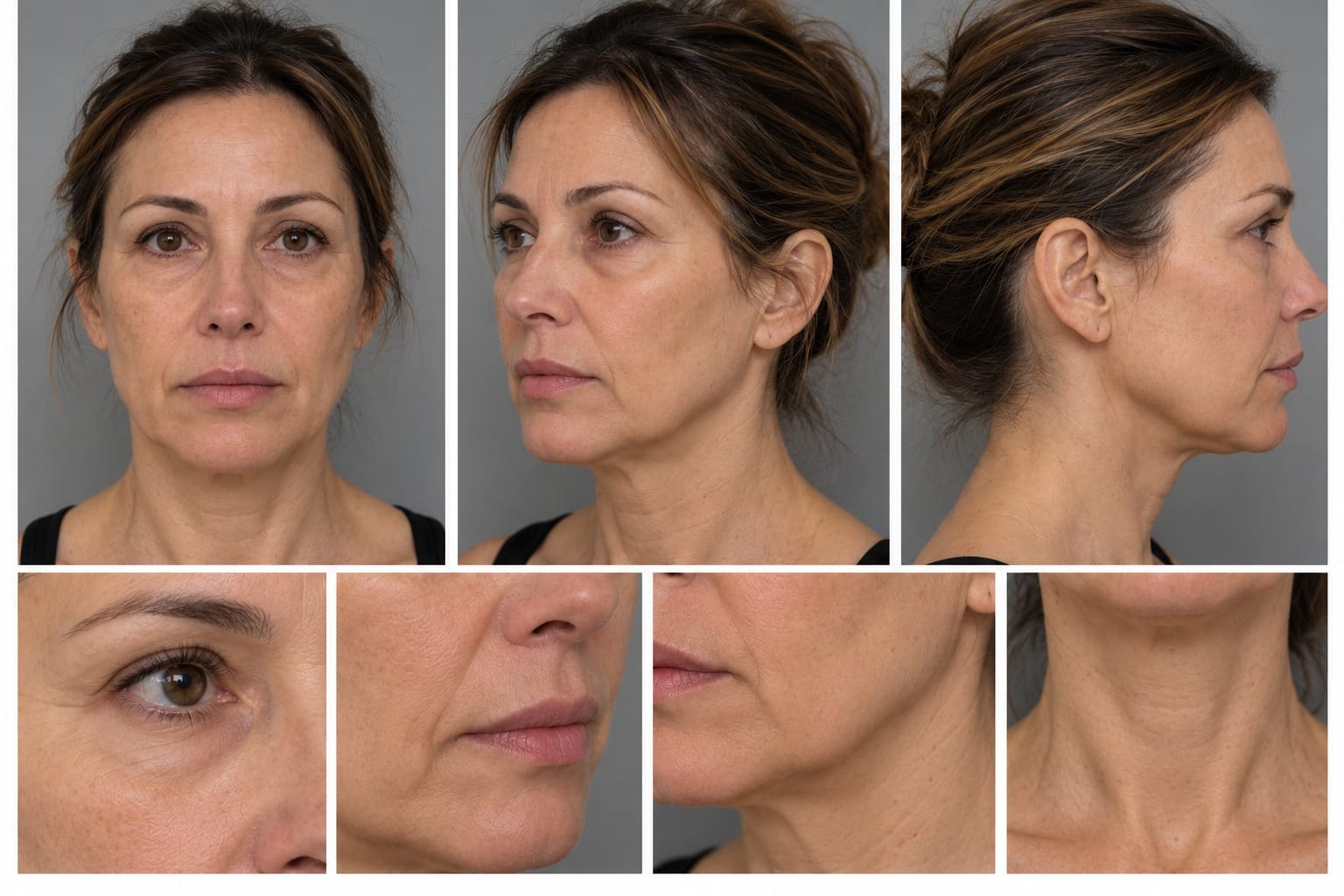
How would you approach this patient's facial rejuvenation? Would you favour more extensive tissue release, a limited approach, or selective release with preservation of supporting attachments?
What would guide your decision?
We'll return to the surgical reasoning in the next edition.
Last month, we presented a 52-year-old woman requesting an upper blepharoplasty because her eyelids felt heavy and she looked tired.
The key finding was frontalis compensation. Once the forehead was relaxed, the lateral brow descended, revealing true brow ptosis alongside genuine upper eyelid skin excess.
My preference would be a combined approach: brow repositioning with a conservative upper blepharoplasty.
Upper blepharoplasty alone would address the excess skin but leave the brow component untreated. A brow lift alone would improve brow position but leave the dermatochalasis.
The takeaway: Before deciding what to remove, make sure you understand what has moved. The patient's complaint may point you towards the eyelid, but the anatomy might tell a different story.
The Plan
From the Patient's Concerns to Surgical Planning
Facial ageing is not simply a matter of skin laxity or tissue descent. It is a multidimensional process involving changes in skeletal support, superficial and deep fat compartments, soft-tissue position, retaining structures, and skin quality.
Before choosing a facelift technique, we need to translate the patient's concerns into specific anatomical findings and, ultimately, into surgical objectives.
What do we see in this patient?
- Midface: Mild soft-tissue descent, with accentuation of the nasolabial folds.
- Lower face: Early jowl formation and reduced definition of the mandibular contour.
- Perioral region: Visible marionette lines.
- Neck: Mild skin laxity and reduced definition of the cervicomental contour.
- Skin quality: Relatively good, with moderate age-related changes.
These findings help define the areas to address, but they do not automatically determine a specific technique.
The next question is anatomical: Which tissues require mobilisation, and which attachments are best left intact?
Hot Topics
Three questions in Modern Facelift Surgery
1. The SMAS: Are We Thinking About It Correctly?
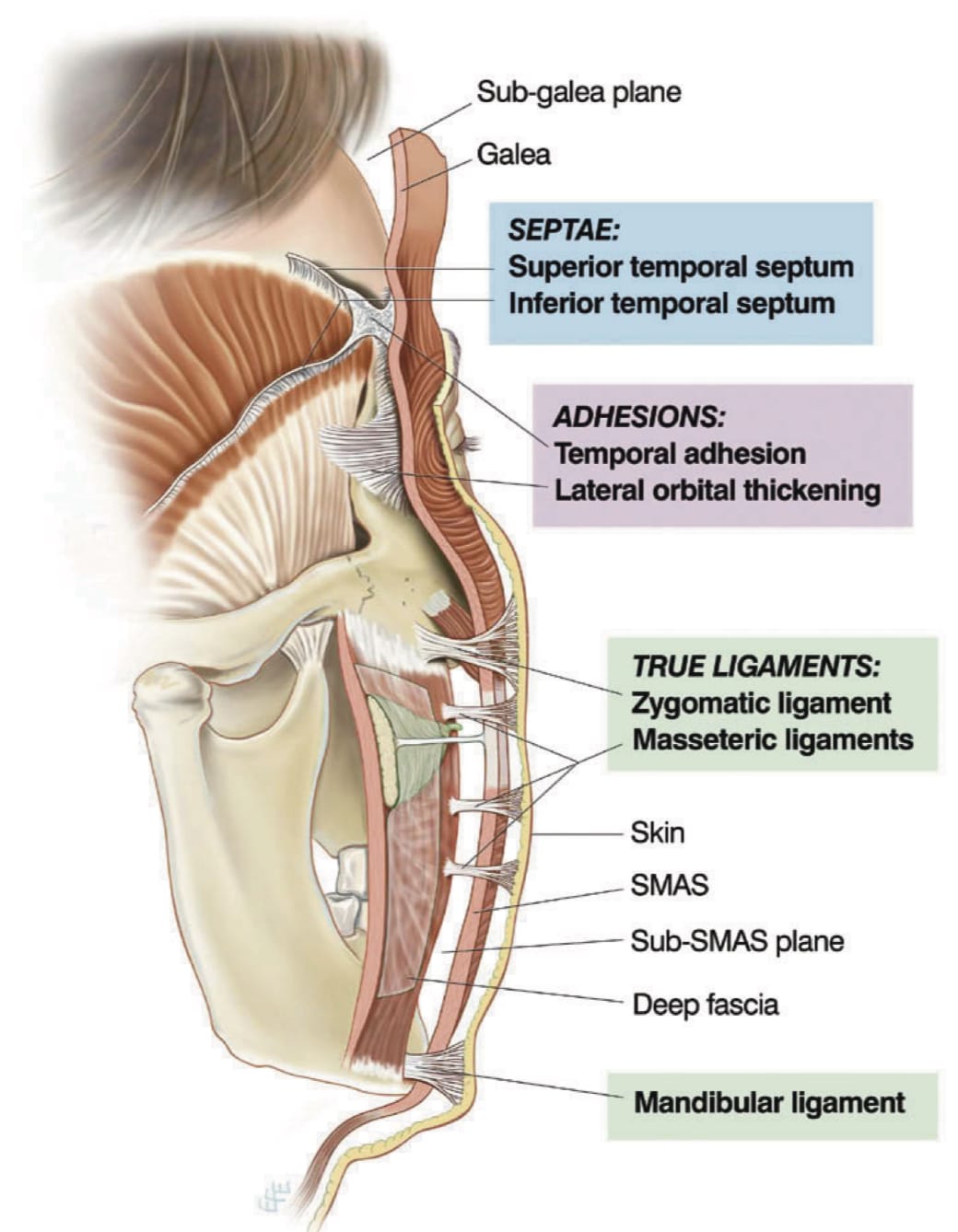
When discussing modern facelift surgery, few terms generate as much ongoing debate as the SMAS (Superficial Musculoaponeurotic System).
Traditionally viewed as a uniform fibromuscular sheet, anatomical evidence from Minelli et al. (2024) highlights that the facial sub-SMAS architecture involves delicate gliding planes, deep fascial structures, and potential spaces.
While debate continues regarding whether the SMAS is a distinct histological layer or a functional composite, the practical reality remains unchanged: it serves as a key mechanical complex that we manipulate, elevate, plicate, or reposition during surgery.
Regardless of its name or strict boundaries, understanding this layer and how it interacts with underlying glideplanes and retaining ligaments remains fundamental to successful facial rejuvenation.
2. Retaining Ligaments: The Art of Letting Go
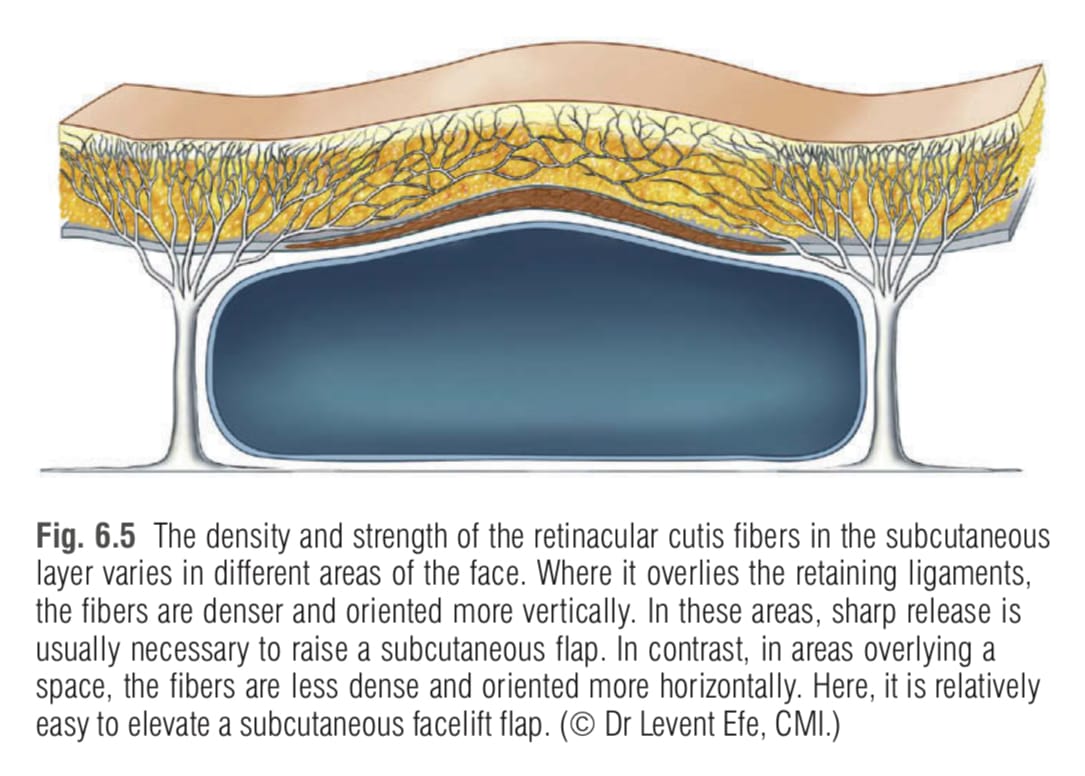
Retaining ligaments act as anatomical anchors connecting deep periosteum or fascia to more superficial facial tissues, contributing to the structural support of the face.
In facelift surgery, these attachments become particularly relevant when tissue mobilisation and repositioning are required.
The extent of ligament release remains a key point of debate.
Deep-plane techniques involve releasing selected retaining attachments to facilitate tissue mobilisation and repositioning, whereas SMAS plication, imbrication, and stacking techniques can achieve facial rejuvenation through different patterns of tissue manipulation and suspension.
The goal is not to release everything or to preserve everything, but to understand which attachments matter for the planned manoeuvre.
3. Skin Undermining: Preservation by Design
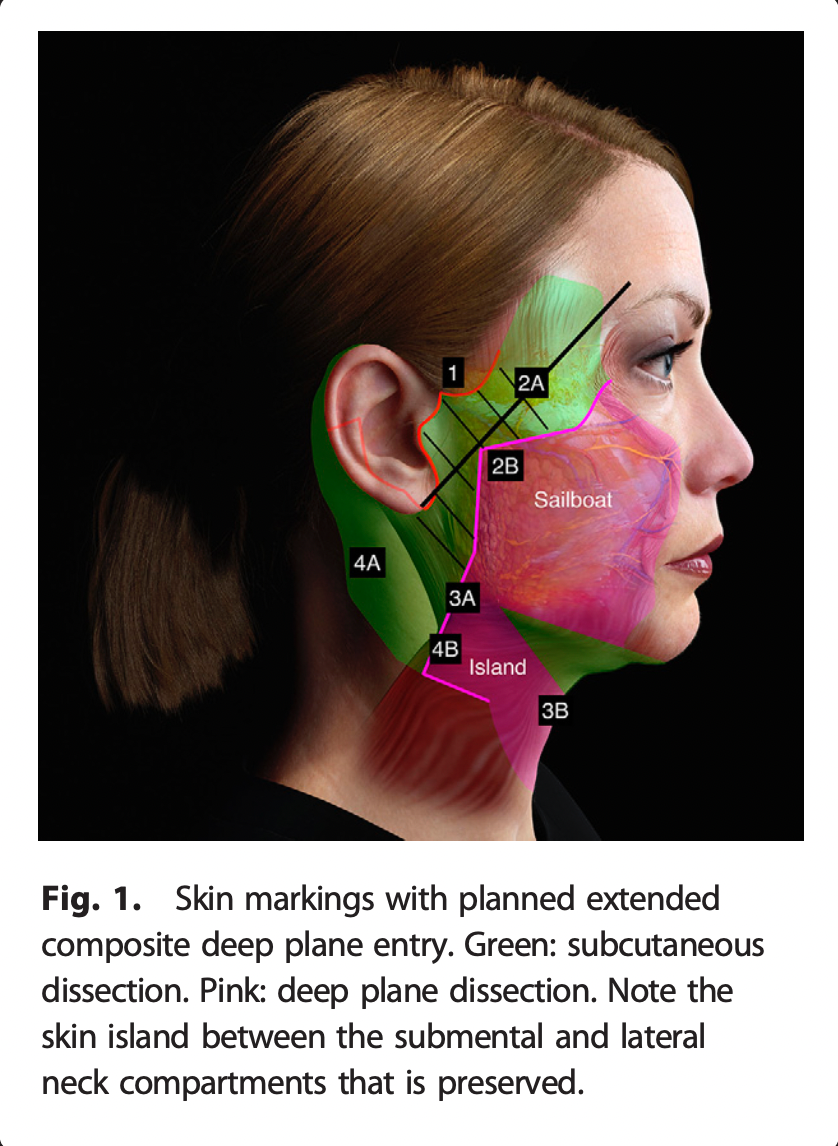
Building on Rohrich et al.'s work on facial fat compartments, we recognise that fibrous septa and retaining structures contribute to the organisation and support of the facial soft tissues.
Expanding on this anatomical understanding, Roskies et al. (2024) describe a modified extended deep-plane technique that preserves selected fibrous septa and skin-SMAS attachments while releasing deeper retaining ligaments.
This approach aims to:
- Improve flap biomechanics by maintaining selected connections within the composite flap.
- Preserve vascular integrity by limiting disruption of superficial tissue attachments and their associated blood supply.
- Respect lymphatic pathways, with potential implications for postoperative swelling and recovery.
These proposed advantages are encouraging, although further comparative evidence is needed to establish their clinical impact.
Ultimately, understanding facial anatomy and tissue biomechanics is crucial to achieving effective rejuvenation while maintaining flap stability and safety.
No single technique has been proven universally superior. The important question is whether the chosen dissection and release provide the mobilisation needed for the individual patient.
Take it to the Clinic
From the Face to the Plan
Before choosing a facelift technique, define what needs to move, what may be restricting that movement, and which structures can safely be preserved.
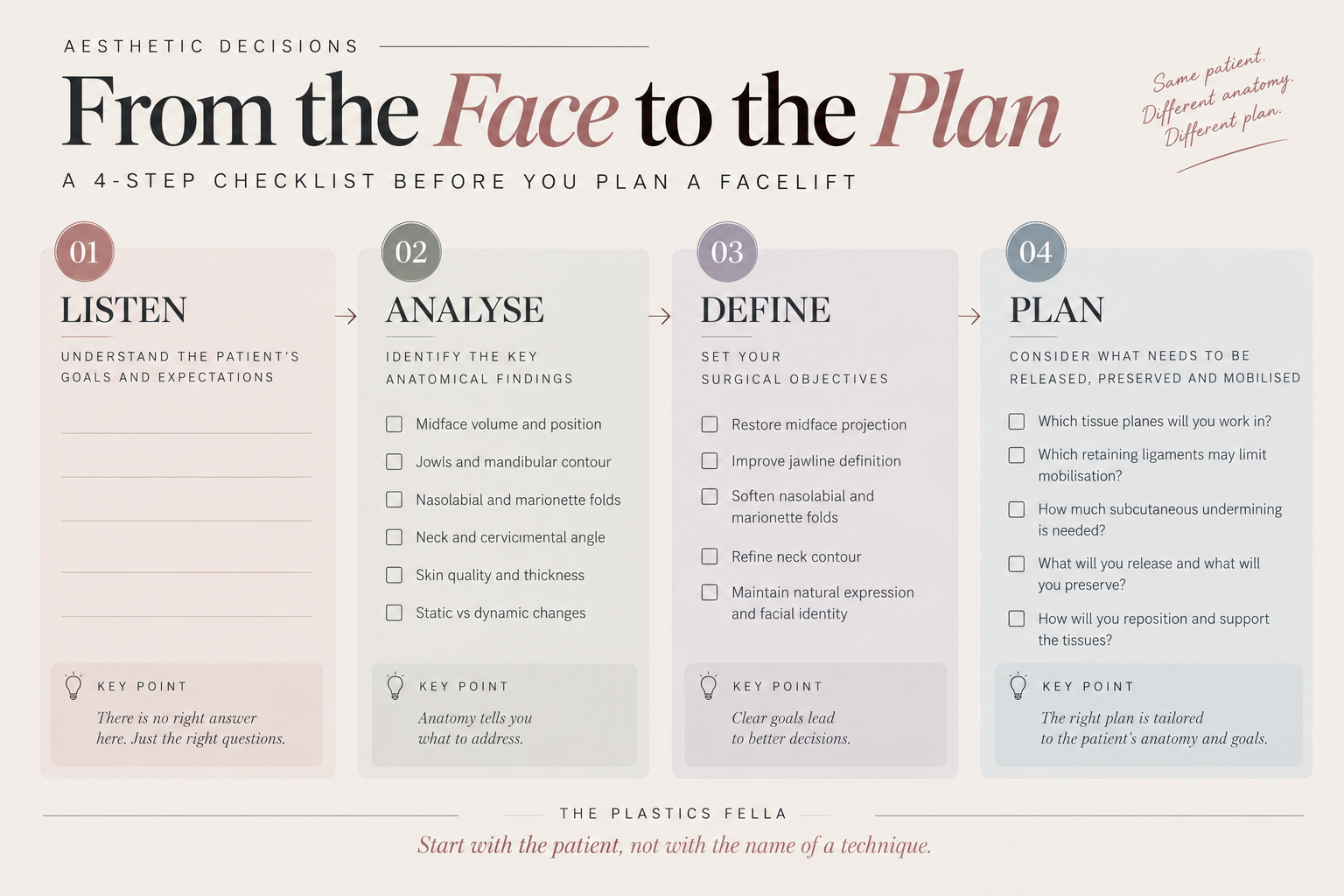
The extent of dissection should follow the anatomical problem, not the other way around.
3 Papers Worth Reading
Evidence & Further Reading
Limited Delamination Modifications to the Extended Deep Plane Rhytidectomy: An Anatomical Basis for Improved Outcomes
Explores limited delamination modifications to extended deep-plane rhytidectomy, their anatomical rationale, and reported clinical outcomes. A useful read when considering the balance between tissue mobilisation and preservation.
Anatomy of the Facial Glideplanes, Deep Plane Spaces, and Ligaments: Implications for Surgical and Nonsurgical Lifting Procedures
Examines facial glideplanes, deep-plane spaces, and retaining structures, providing an anatomical framework for understanding tissue mobility and the implications of surgical release.
The Fat Compartments of the Face: Anatomy and Clinical Implications for Cosmetic Surgery
A foundational anatomical paper demonstrating that facial fat is organised into distinct compartments rather than a single continuous layer. Essential reading for understanding how different facial regions age and respond to repositioning.
Before You Leave
The question is not simply whether to release or preserve. It is knowing why we are doing either.
As we continue to refine facelift techniques, the anatomy should remain at the centre of every decision.
See you in the next edition,
Dr. Benedetta Agnelli
Dr. Vanessa Restrepo

