


In this week's edition
- ✍️ Letter from P'Fella
Beyond articles: Bringing Plastics education live - 🖼️ Image of the Week
Extending the reach of reconstruction - 🚑 Technique Tip
Anterolateral Thigh (ALT) free flap harvest - 🎧 How I Operate
How I Operate with Dr. Elizabeth Hall-Findlay - 📖 What Does the Evidence Say?
Does the 72-hour rule still matter? - 🔥 Articles of the Week
The superficial femoral artery, pedicled vs. free flaps, & ALT vs. latissimus dorsi free flaps. - 💕 Feedback
Suggest ideas & give feedback!
A Letter from P'Fella
Beyond Articles: Bringing Plastics Education Live
So, we've been thinking, what comes after the articles and the Foundations textbook?
For years, our focus has been on building resources that you can come back to whenever you need them. Articles, illustrations, podcasts, newsletters, and now we're expanding into department-based resources.
That's still at the heart of what we do. But the more we speak to people around the world, the more we realise that there's something those resources can't fully replace: learning together.
There's something different about being able to ask a question in real time. To hear why a consultant made one decision over another. To spend an hour diving into a single topic instead of trying to piece it together from ten different sources. That's the direction we've started thinking about.
At the moment, it's just an idea. But it's an idea we're quite excited about.
We're exploring the possibility of running live, department-based webinars with our department heads and the experts we're already working alongside. Rather than trying to cover everything at once, we'd focus on one subject at a time. It could be a single evening webinar on facelift planning. Eventually, we'd like to turn it into something longer-term, like a small cohort spending five evenings working through facial aesthetics together. We don't want to conduct lectures for the sake of lectures, but sessions that are practical, interactive, and centred around what people actually want to learn.
Naturally, our plan is to start with the Aesthetics Department. We've already built an incredible group of people around it, and it feels like the right place to begin. If it works well, we'd love to gradually bring the same format to lymphovascular surgery, hand surgery, burns, and the other departments we're building.
We're still very much at the drawing board, so we're not looking for detailed feedback just yet. We'd simply like to know whether this is something you'd actually attend.
If a live cosmetics webinar sounds interesting to you, let us know. We'll keep you updated as the idea develops and let you know when we're launching the first session.
P’Fella ❤️
Image of the Week
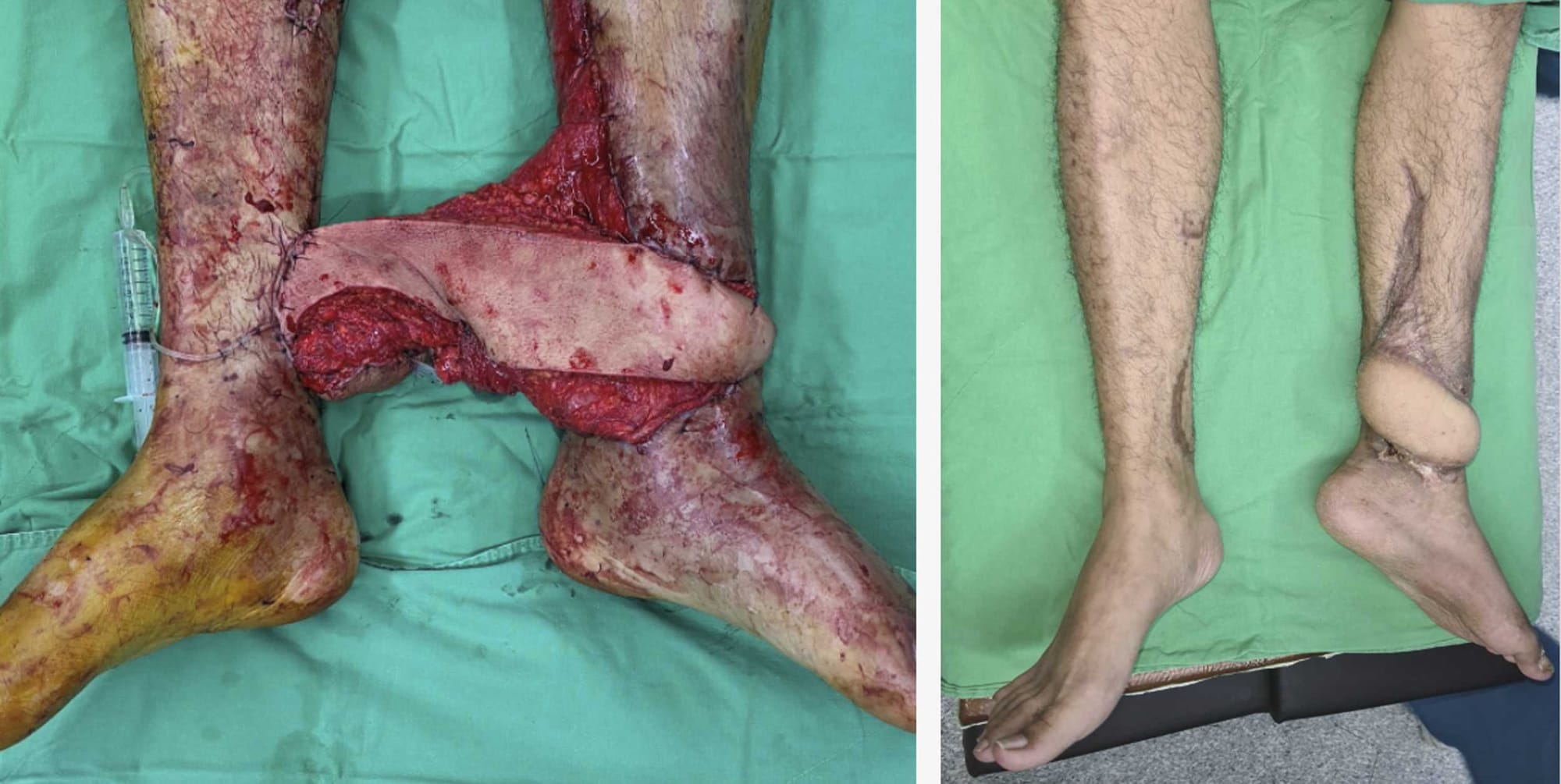
Extending the Reach of Reconstruction
This case demonstrates one of the most challenging scenarios in lower limb reconstruction: when the defect extends beyond what a single free flap can reliably reach.
In patients with devastating lower limb trauma and no usable recipient vessels, the healthy limb can temporarily provide the blood supply needed for reconstruction. Once the transferred tissue has established its own circulation, the bridge is divided, leaving durable soft tissue coverage where conventional reconstruction would otherwise be impossible.
Technique Tip
Anterolateral Thigh (ALT) Free Flap Harvest
The anterolateral thigh (ALT) flap is the workhorse free flap for lower limb reconstruction, providing a long vascular pedicle, reliable perforators, and ample soft tissue with minimal donor-site morbidity. Its versatility allows reconstruction of traumatic defects ranging from exposed bone and tendon to complex Gustilo IIIB fractures.
This operative video demonstrates the key steps of ALT flap harvest, including perforator identification, intramuscular pedicle dissection, and flap elevation.
How I Operate
How I Operate with Dr. Elizabeth Hall-Findlay
Ryan Sugrue sits down with Elizabeth Hall-Findlay for a conversation on breast reduction, mastopexy, and the evolution of modern breast surgery.
This episode explores how surgical ideas develop over time, through anatomy, experience, honest reflection, and the willingness to question long-held assumptions.
What Does the Evidence Say?
Does the 72-Hour Rule Still Matter?
Subsequent evidence has largely supported the principle of early definitive coverage, even if the exact 72-hour threshold is less absolute than once thought. Meta-analysis has shown that reconstruction within 72 hours is associated with lower flap failure, infection, and need for additional procedures compared with delayed reconstruction. More recent pooled data in open lower-extremity fractures similarly found that coverage within 72 hours was associated with a 52% lower risk of infection, while coverage within 7 days was also associated with a 50% reduction in infection and lower nonunion risk.
The practical message is therefore less “72 hours or failure” and more cover early once adequate debridement, fixation, and patient optimisation have been achieved. Contemporary series suggest that reconstruction between 72 hours and roughly 7-10 days can still produce good outcomes, but prolonged delay is consistently associated with increasing infectious and wound complications.
(Godina, 1986); (Gopal, 2000); (Haykal, 2018); (Tiongco, 2025); (Habarth-Morales, 2025)
Articles of the Week
3 Interesting Articles with One-Sentence Summaries
Despite its distance from the defect, the superficial femoral artery provides reliable anatomy, robust blood flow, and excellent outcomes, making it a valuable option for complex knee reconstruction when local recipient vessels are compromised.
This review found that pedicled flaps achieved outcomes comparable to free flaps with fewer and less severe complications, supporting them as the preferred first-line option for many distal leg and foot soft tissue defects.
Both ALT and latissimus dorsi free flaps achieved similar long-term functional results for distal lower limb reconstruction, but the ALT flap offered better aesthetics and lower donor site morbidity.
