


In this week's edition
- ✍️ Letter from P'Fella
Does good practice look the same everywhere? - 🤓 The Sunday Quiz
Get ready for Week Five! - 🖼️ Image of the Week
If a scalp graft fails - 🚑 Technique Tip
Scalp rotation flap - 📖 What Does the Evidence Say?
Can dermal regeneration templates replace free flaps? - 🔥 Articles of the Week
Free, local, and rotation flaps for scalp recon. - 💕 Feedback
Suggest ideas & give feedback!
A Letter from P'Fella
Does Good Practice Look the Same Everywhere?
A burn referral in one country might go straight to a specialist unit. Somewhere else, it may be managed locally for much longer. A lower-limb injury might have access to microsurgery, rehabilitation, and regular follow-up in one centre, while another team is working with far fewer resources. Even something as basic as who manages the patient, when they are referred, and what equipment is available can completely change the decisions being made.
That makes building an international curriculum more complicated than simply collecting the “best” scientific evidence and putting it in one place.
There are principles that should travel well: anatomy, assessment, wound preparation, reconstructive thinking, patient safety, and knowing when to ask for help. But the way those principles are applied has to leave room for local practice. There isn’t much value in teaching an ideal pathway if half the people reading it could never use that pathway where they work.
I think the useful question is: how do we teach a shared foundation?
Part of the answer has to come from the people already working in those systems. That context doesn’t weaken an international curriculum. It makes it more honest.
This is one thing we want to explore through our upcoming Grassroots Global live events. Bringing people from different countries into the same discussion gives us a chance to compare approaches properly, rather than assuming one version of practice should be treated as universal.
We’re also thinking about building a more informal community space alongside it. Something closer to a WhatsApp or Telegram group, where medical students, trainees, fellows, and consultants can share ideas, techniques, useful papers, and the practical tips that may not make it into formal teaching.
It’s still an early idea, so before we take it any further, we’d like to know whether it’s something you would like to be part of.
P’Fella ❤️
The Sunday Quiz
Get Ready for Week Five!
Each week, we'll put your plastic surgery knowledge to the test with a new question designed to challenge you and keep you thinking. Join in every Sunday, keep your wits about you, and compete for the top spot. The winner at the end of eight rounds will receive 6 months of Plastics Pro, on us.
Image of the Week
If a Scalp Graft Fails
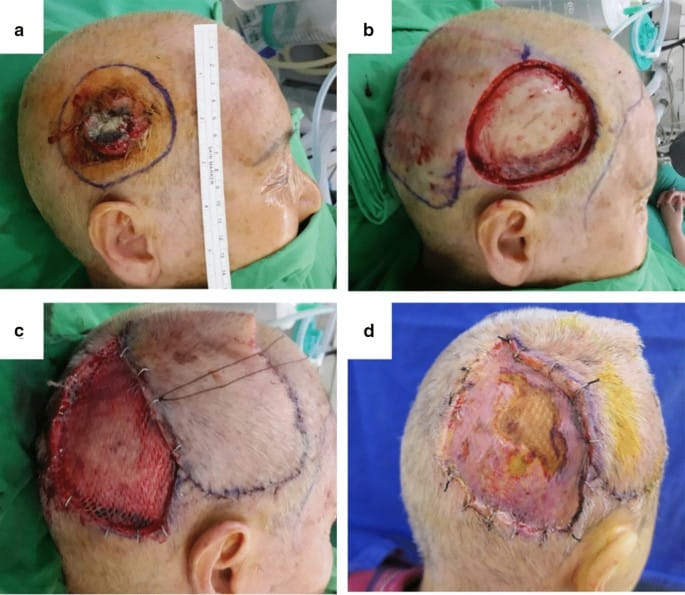
Scalp reconstruction becomes more challenging when wide tumour excision leaves exposed calvarium, particularly when the pericranium has been removed and there is no suitable vascular bed for skin grafting.
This image shows a 75-year-old patient undergoing excision of a temporoparietal squamous cell carcinoma, followed by reconstruction with a local transposition flap. The flap covered the exposed bone, while its donor site was resurfaced with a meshed split-thickness skin graft (STSG). However, partial graft loss subsequently left the donor site with exposed bone.
A flap can provide vascularised coverage where a graft cannot reliably survive, but the donor site must also be considered. In this patient, the complication was later salvaged using the crane principle, returning the flap to its original location while leaving vascularised tissue behind to support grafting at the initial defect.
Technique Tip
Scalp Rotation Flap
Rotation flaps are a useful option for reconstructing scalp defects where limited tissue laxity makes primary closure difficult.
This operative video demonstrates reconstruction of a posterior scalp defect following wide local excision of melanoma in situ. The procedure illustrates rotation flap design, mobilisation of adjacent scalp tissue, and flap advancement into the defect to achieve local tissue coverage.
What Does the Evidence Say?
Can Dermal Regeneration Templates Replace Free Flaps?
The wider literature is encouraging but methodologically limited. A systematic review of 34 reports found that 32 reported mean graft take of at least 90%, with no major template-related complications; however, wound characteristics were too heterogeneous for quantitative comparison. In a subsequent JPRAS cohort, 84% of wounds achieved complete coverage within 90 days, while postoperative infection strongly predicted failure and previous radiotherapy was also associated with poorer outcomes. More recent data reinforce that limitation: estimated two-month template survival was 91% in nonirradiated defects but 65% after previous scalp irradiation.
The evidence therefore supports dermal regeneration templates as an alternative to free flaps in carefully selected patients, particularly for nonirradiated defects with a wound bed capable of supporting vascular ingrowth and where staged healing is acceptable. They should not be considered a universal replacement for vascularised tissue. For composite scalp-calvarial defects, exposed dura or cerebrospinal fluid leakage, heavily irradiated or contaminated wounds, and cases requiring immediate durable coverage, PRS series continue to support free-tissue transfer. The current evidence is best interpreted as supporting selective substitution, not a new reconstructive default.
(Othman, 2022); (Johnson, 2016); (Othman, 2021); (Yang, 2024); (Wang, 2007)
Articles of the Week
3 Interesting Articles with One-Sentence Summaries
Scalp reconstruction depends on more than defect size, with the choice between primary closure, local flaps, and free tissue transfer guided by five reconstructive categories, helping surgeons plan adequate tumour excision and minimise repeat procedures.
Local and regional flaps can successfully reconstruct selected scalp defects up to 80 cm², with only 10% of patients requiring revision surgery, suggesting that even relatively large defects may not always require free tissue transfer.
Scalp rotation flaps need to account for the skull’s three-dimensional curvature, not just defect size, with a 30° triangular design helping calculate flap dimensions and achieve complete healing without complications.
