


In this week's edition
- ✍️ Letter from P'Fella
Remembering Dr Alexander Aslani - 🤓 The Sunday Quiz
Welcome to the first round - 🖼️ Image of the Week
Jackson’s 3 zones of burn injury - 🚑 Technique Tip
Split-thickness skin grafting guide - 🎓 Building in Public
Something new is coming to Grassroots - 📖 What Does the Evidence Say?
When should a burn be excised and grafted? - 🔥 Articles of the Week
Burn depth assessment, laser Doppler imaging, & early excision. - 💕 Feedback
Suggest ideas & give feedback!
A Letter from P'Fella
In Loving Memory of Dr Alexander Aslani
Dr Aslani made a significant contribution to the field of plastic surgery, particularly in body contouring, where he established himself as a true pioneer. Patients travelled from all over the world to seek his expertise. Among his most recognised contributions was the Supercharged BBL, a hybrid technique combining gluteal implants with fat transfer. The BBL remained one of his most sought-after procedures, and one he continued to refine over the years in his pursuit of better outcomes.
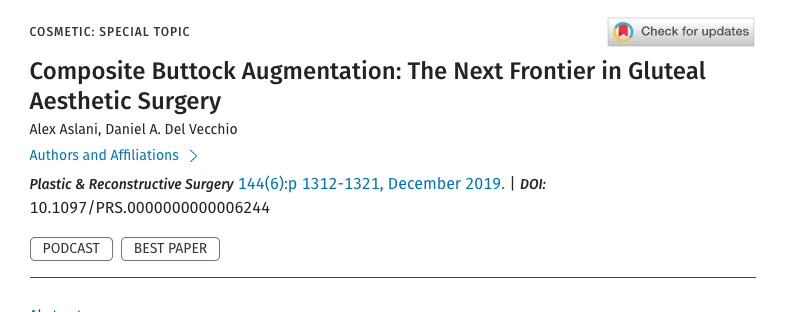
His academic work reflected that same commitment to advancing the field. In 2019, he co-authored Composite Buttock Augmentation: The Next Frontier in Gluteal Aesthetic Surgery in Plastic and Reconstructive Surgery, describing an approach combining implants with fat grafting. This was followed by further work on the anatomy and design of the dual-plane technique, the combination of fat and implants for gluteal augmentation, and, most recently, an analysis of outcomes using cohesive gel implants with the dual-plane technique.
Recognising the complexity and risks associated with gluteal fat grafting, Alex placed great importance on rigorous perioperative protocols and patient safety. His dedication to refining surgical techniques, studying their outcomes, and sharing his experience helped advance the field of modern body contouring. But his contribution to plastic surgery cannot be measured by publications or surgical techniques alone.
Alex embodied the very essence of a surgeon. Despite his extensive experience and the recognition he had earned throughout his distinguished career, he never stopped learning, questioning, and pushing boundaries. Driven by an extraordinary combination of knowledge, curiosity, discipline, and passion, he viewed excellence not as a destination, but as a lifelong pursuit.
What made him truly exceptional, however, was not only his surgical expertise, but his willingness to share his knowledge with others. He taught and mentored countless colleagues from all over the world, leaving a lasting mark on generations of surgeons.
There were no secrets, no reluctance to share what he had learned, and no hesitation to help others grow. Yet, remembering Alex means remembering not only the exceptional surgeon he was, but also the man himself: kind, funny, full of life, a devoted husband and father, and a mentor who inspired all those fortunate enough to know him.
Beyond the operating room and his professional achievements, it was his warmth, humour, and the countless conversations and memories he shared with others that made working alongside him so special. For those who had the privilege of knowing him, his absence leaves a void that words can hardly express.
His loss is immeasurable for his family, who have lost a beloved husband and father. It is deeply felt by everyone who worked with him, learned from him, and loved him. It is also a profound loss for the international plastic surgery community, which has lost one of its greats.
This tribute is a way of honouring all that Alex contributed to our specialty, the knowledge he shared so generously, and the countless people he inspired along the way. His influence will live on through the surgeons he taught, the techniques he helped advance, the lives he touched, and the example he set of what it truly means to be a surgeon.
Thank you, Alex, for everything you taught us, everything you gave us, and everything you were.
You will be deeply missed and forever remembered.
With profound respect, gratitude, and love,
Vanessa Restrepo
The Sunday Quiz
Welcome to the First Round
Are you ready for a fresh round of The Weekly Quiz?
Each week, we'll put your plastic surgery knowledge to the test with a new question designed to challenge you and keep you thinking. Join in every Sunday, keep your wits about you, and compete for the top spot. The winner at the end of eight rounds will receive 6 months of Plastics Pro, on us.
Image of the Week
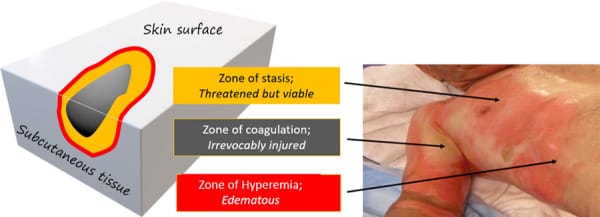
Jackson’s 3 Zones of Burn Injury
A burn isn't a single area of uniform tissue damage. Jackson's model describes three concentric zones, each with a different potential for recovery.
At the centre is the zone of coagulation, where tissue damage is irreversible. Surrounding it is the zone of stasis, where reduced perfusion leaves tissue injured but potentially salvageable. The outer zone of hyperaemia has increased blood flow and typically recovers without permanent damage.
The critical zone is stasis. Without adequate perfusion and appropriate burn care, this tissue can progress to necrosis, deepening the original injury. This is why early burn management is not just about treating the damage already present, but preventing further tissue loss.
Technique Tip
Split-Thickness Skin Grafting Guide
Split-thickness skin grafting (STSG) is a fundamental technique in burn reconstruction, providing wound coverage following excision of non-viable tissue. Successful graft take depends on a well-vascularised wound bed, adequate haemostasis, and close contact between the graft and recipient site, with minimal shear or fluid accumulation.
Building in Public
Something New Is Coming to Grassroots
We started small, with an in-person teaching organised locally in Malaysia. Now we’re trying to see how far we can take it.
Over the past few weeks, we’ve been expanding our Grassroots team to bring a new international live teaching series. The plan is to bring together trainees from different parts of the world for a series of webinars on a designated sub-specialty, with a different sub-topic each week.
One thing we are putting a lot of effort into is making sure these do not feel like another webinar where you log on, listen to someone speak for an hour, and disappear.
We’re working on ways to make the sessions much more hands-on. You might be asked to mark your operative plan, work through a clinical decision before hearing how an expert approaches it, or compare your answer with everyone else in the room. We’ll then keep the conversation going between sessions with shorter teaching, clips, and useful resources from what came up that week.
But we wanted to ask, what would actually make you want to turn up to a webinar during the weekend? Is there a topic you’d like us to tackle, a surgeon you’d like to learn from, or an activity you think would make the sessions genuinely useful?
Send us your ideas, and we’ll take them into the planning for the first Grassroots series.
If you’ve followed Grassroots since the early days, this is a much bigger version of what we originally hoped it could become: people learning plastic surgery together, wherever they happen to be training.
What Does the Evidence Say?
When Should a Burn Be Excised and Grafted?
Randomised clinical evidence also supports early excision in appropriately selected deep burns. In indeterminate-depth burns involving less than 20% TBSA, early excision and grafting shortened hospital stay and time away from work and reduced the need for later grafting compared with conservative treatment. In major burns, early excision has also been associated with improved outcomes in selected patient groups. However, early assessment is not perfect: in indeterminate scald burns, delaying excision allowed some wounds to declare themselves and heal without surgery, reducing the amount of tissue excised.
The practical takeaway is therefore not simply “graft early.” Full-thickness burns generally require excision and grafting, while deep partial-thickness burns should be judged by depth, anatomical site, functional importance, and expected healing time. If a wound is unlikely to epithelialise by around 21 days, the balance increasingly shifts toward excision and grafting to reduce prolonged healing and hypertrophic scar risk.
(Engrav, 1983); (Herndon, 1989); (Deitch, 1983); (Cubison, 2006); (ISBI Practice Guidelines Committee, 2016)
Articles of the Week
3 Interesting Articles with One-Sentence Summaries
Clinical assessment correctly identifies burn depth in only 60-75% of cases, compared with approximately 95% accuracy using laser Doppler imaging, which can better predict healing potential and guide decisions on excision and grafting.
A review of burn assessment techniques found that laser Doppler imaging can predict healing potential up to 2 days earlier than clinical judgement, helping surgeons identify wounds requiring excision and grafting while avoiding unnecessary operations.
In a randomised study of adults with burns covering over 30% TBSA, early excision reduced mortality from 45% to 9% in patients aged 17-30 without inhalation injury, although no significant survival benefit was demonstrated in older adults or those with inhalation injuries.
