


In this week's edition
- ✍️ Letter from P'Fella
A little more time for aesthetics - 🖼️ Image of the Week
Supporting the nasal tip - 🚑 Technique Tip
Lateral osteotomies in rhinoplasty - 🎓 Building in Public
Updates with our on-call team - 🎧 How I Operate
Air bubbles in the arterial anastomosis - 📖 What Does the Evidence Say?
Preventing the inverted-V deformity - 🔥 Articles of the Week
Aesthetic nasal tip, nasal tip support, & open rhinoplasty. - 💕 Feedback
Suggest ideas & give feedback!
A Letter from P'Fella
A Little More Time for Aesthetics
I’d like our monthly Aesthetics newsletter to give you a little of that experience.
The first edition is nearly ready, and there’s one part of the format I’m particularly pleased with. You get to consider the case before reading through the assessment. In this first edition, you’re invited to think about what you would recommend for a patient with a specific request, including whether you have enough information to recommend anything yet.
As you read on, we introduce the findings and explain how they influence the proposed approach. You can see where your thinking agrees, where it differs, and what you might have wanted to examine more closely.
This is a more effective way of teaching. It’s easy to read an explanation after being given the answer and think, yes, that makes sense. Having a go yourself first makes it a different read. You have a reason to pay attention to the assessment because you’ve already started forming a view. And I hope that even someone with years of experience would find things to discuss. We’re presenting a clinical perspective, with the reasoning behind it, so there should be room to consider how it compares with your own practice.
Putting the edition together has also meant making some decisions about how much to include. Certain clinical decisions could easily fill several issues. For this one, we’ve kept returning to the patient in front of us and the details that would affect the consultation.
Having a dedicated Aesthetics Department gives us room to develop something a little different alongside the weekly Plastics Paper. We are excited to keep returning to the specialty each month, work through another case or question, and hear what you think we should cover next. There’s plenty still to work out as we go, but I’m looking forward to getting the first edition into your hands and hearing how you find it.
The Aesthetics mailing list is open below.
P’Fella ❤️
Image of the Week
Supporting the Nasal Tip
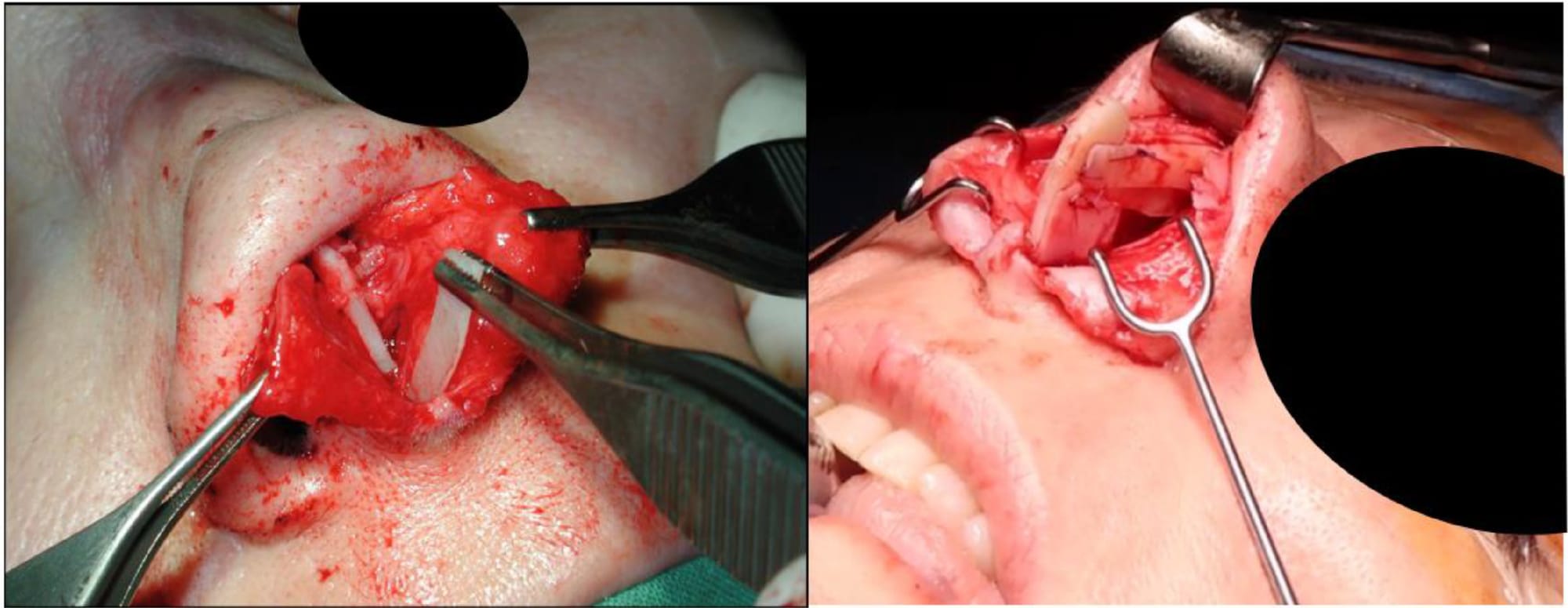
These images show two different ways of creating structural support during rhinoplasty. On the left, a columellar strut graft sits between the medial crura, reinforcing the existing tip-support mechanism. On the right, a septal extension graft is fixed directly to the septum, creating a more rigid framework from which tip position can be controlled.
The distinction matters. A columellar strut primarily supports the tip, whereas a septal extension graft gives the surgeon greater control over tip projection and rotation by effectively extending the caudal septal framework.
Technique Tip
Lateral Osteotomies in Rhinoplasty
Lateral osteotomies allow controlled mobilisation of the nasal bones and are commonly used to narrow the bony vault, correct asymmetry, or close an open-roof deformity following dorsal reduction. Precise osteotomy placement and controlled fracture are important for maintaining smooth dorsal aesthetic lines while avoiding unintended comminution or irregularity.
This operative video demonstrates lateral osteotomies using an endonasal approach, showing how the nasal bones are mobilised and repositioned to achieve a narrower, more symmetrical bony vault.
Building in Public
Updates with Our On-Call Team
One of our longest-running issues is finding good clinical images we can actually use, and we are currently planning on adding a new team role to help us create custom images for the Library.
We also gave the team an early look at the new learning platform we’ve been building, which brings articles, images, videos, and notes into one workspace, and they’ll be testing it out over the next few weeks.
Last but not least, we discussed what’s coming from the Aesthetics Department, including our first specialist newsletter, webinars, and more to come.

How I Operate
Air Bubbles in the Arterial Anastomosis
In this clip, Pedro Cavadas talks about a small detail that can have a big consequence: air bubbles in the arterial anastomosis.
His point is that some cases we call “no-reflow” may not be mysterious at all. They may be tiny air emboli blocking flow in a small perforator or replant. Before tying the final stitch, he makes sure the air is flushed out.
What Does the Evidence Say?
Preventing the Inverted-V Deformity
Later work reinforced the same principle: preserving the upper lateral cartilages during dorsal reduction and reconstructing the middle vault when necessary helps maintain both dorsal aesthetic lines and internal nasal valve function. However, the evidence does not support one mandatory technique for every patient. Systematic reviews comparing spreader grafts and spreader flaps show broadly similar functional and aesthetic outcomes, with no clear difference in overall complication rates.
The practical takeaway is therefore not “everyone needs a spreader graft,” but that middle-vault support must be actively assessed and preserved after dorsal reduction, using spreader grafts, spreader flaps, or another appropriate reconstructive technique when the upper lateral cartilages are at risk of collapse.
(Sheen, 1984); (Rohric, 2004); (Gruber, 2007); (Keyhan, 2022); (Fallahi, 2022)
Articles of the Week
3 Interesting Articles with One-Sentence Summaries
Analysis of 50 primary open rhinoplasties identified three key nasal tip angles: tip rotation, domal definition, and domal divergence that can be defined anatomically and deliberately shaped during surgery.
Cadaveric dissection consistently identified five ligamentous structures around the nasal tip, supporting preservation of these ligaments to help control tip projection, position, and rotation during rhinoplasty.
Open rhinoplasty produced significantly greater loss of tip projection than the closed approach (3.43 mm vs 1.98 mm), supporting active measures to maintain tip support when ligamentous structures are disrupted.
