


In this week's edition
- ✍️ Letter from P'Fella
Help us build the next version of Plastics Pro - 🖼️ Image of the Week
Preoperative planning and dermal flap design for breast reduction - 🚑 Technique Tip
C-V flap for nipple reconstruction - 🎓 Building in Public
Monthly specialist newsletter: Aesthetics department - 🎧 How I Operate
Upcoming episode of How I Operate: Elizabeth Hall-Findlay - 📖 What Does the Evidence Say?
Is a free nipple graft still necessary? - 🔥 Articles of the Week
Breast reduction, pedicle choice, and superomedial pedicle safety. - 💕 Feedback
Suggest ideas & give feedback!
A Letter from P'Fella
Help Us Build The Next Version of Plastics Pro
It's an exciting question because the landscape of digital education is very different from when we first started. Back then, the goal was simply to create better educational articles. Since then, we've added podcasts, newsletters, illustrations, visual learning tools, and the Foundations textbook with its annual updates. What started as a library of articles has gradually become something much bigger.
Now we're at another one of those moments where we need to stop at think before we move forward.
There are lots of directions we want to take. We could focus entirely on the articles themselves, making them more visual and interactive. We could build out every specialty department so articles are continually reviewed and updated by dedicated teams of experts and trainees. We could expand the podcast, create comprehensive flashcard decks for exam preparation, or come up with entirely new ways of learning that we haven't even thought of yet.
The reality is that we can't build everything at once.
That's why we'd like to hear from the people who use Plastics Pro every day. Rather than deciding what the future should look like ourselves, we'd much rather build around those who use the platform regularly. If one feature would genuinely make a difference to your training, we'd love to know and build it for you.
Another thing we're considering is the best way to structure subscriptions in a way that's fair, flexible, and sustainable for everyone. So, let us know your thoughts below.
Thank you for helping us build this together.
P’Fella ❤️
Image of the Week
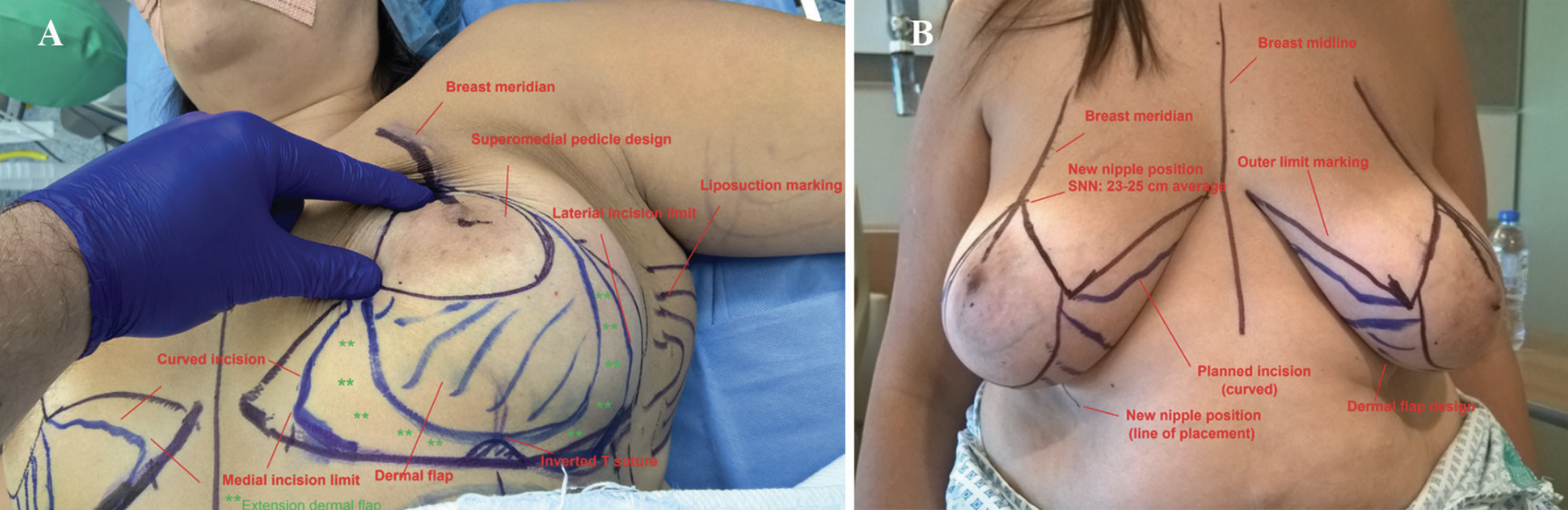
Preoperative Planning and Dermal Flap Design for Breast Reduction
This image demonstrates preoperative marking and pedicle planning for breast reduction.
The superomedial pedicle is outlined along the breast meridian, preserving reliable vascularity to the NAC, while the Wise pattern markings define the final skin envelope. Importantly, the dermal flap design can be extended medially and laterally, allowing the surgeon to tailor resection and shaping to the patient’s anatomy.
Technique Tip
C-V Flap for Nipple Reconstruction
The C-V flap is one of the most widely used techniques for nipple reconstruction following breast reconstruction. By combining local skin flaps to create nipple projection with a full-thickness skin graft for the areola, it provides reliable contour, colour match, and long-term aesthetic outcomes.
This operative video demonstrates the key steps of C-V flap design, flap elevation, nipple inset, and full-thickness skin graft application for reconstruction of the nipple-areolar complex.
Building in Public
Unlike The Plastics Paper, which covers different plastics topics each week, this will be dedicated to one subspecialty every month. We want to bring together landmark papers, expert insights, clinical pearls, and practical ways of thinking about a specialty. And we're starting with Aesthetics.
We're now opening a waiting list while we build the first edition. If you'd like to receive the monthly Aesthetics newsletter, join the mailing list below.
How I Operate
Upcoming Episode of How I Operate: Elizabeth Hall-Findlay
Remove the excess where it is. Rearrange what needs support.
Episode release on Monday!
What Does the Evidence Say?
Is a Free Nipple Graft Still Necessary?
Modern evidence increasingly challenges the idea that breast size, resection weight, or a long sternal-notch-to-nipple distance should automatically trigger free nipple grafting. Nipple-sparing reductions using inferior, medial, or superomedial pedicles have been successfully performed in patients with severe ptosis and very large resections, with low rates of complete nipple loss. A contemporary systematic review found complete nipple-areola complex necrosis to be uncommon after nipple-sparing gigantomastia reduction, although the underlying studies were mostly retrospective and used inconsistent definitions of gigantomastia.
Direct comparative evidence also favours considering an elongated pedicle when technically feasible. In patients with gigantomastia, extended-pedicle reduction produced a similar overall safety profile to free nipple grafting, but better patient-reported nipple satisfaction and superior assessed breast and nipple aesthetics.
Free nipple grafting should be treated as a selective or rescue technique rather than an automatic response to a large breast or long pedicle. The decision should instead reflect intraoperative perfusion, pedicle anatomy, comorbidities, smoking, previous surgery, and the patient’s priorities regarding sensation, lactation, pigmentation, and breast shape.
(Courtiss, 1977); (Chang, 1996); (Zelko, 2023); (Chetty, 2016); (Talwar, 2022)
Articles of the Week
3 Interesting Articles with One-Sentence Summaries
Classic breast reduction principles support avoiding excessive undermining and staging large reductions as key to preventing nipple necrosis and achieving symmetrical, aesthetically balanced outcomes.
Modern vertical breast reduction hinges on selecting a pedicle that reliably preserves NAC vascularity while allowing effective reshaping, reflecting an evolution from staged safety-focused techniques to single-stage procedures that balance blood supply, projection, and scar minimisation.
In Hall-Findlay breast reduction, the NAC blood supply and innervation run superficially within the pedicle, so aggressive thinning or de-epithelialisation risks necrosis and denervation, making deep-plane resection the safer strategy for large-volume reductions.
