


In this week's edition
- ✍️ Letter from P'Fella
What gets lost in a 60-second surgical clip? - 🤓 The Sunday Quiz
Third week rolls around - 🖼️ Image of the Week
Fixing a metacarpal fracture - 🚑 Technique Tip
Plate fixation of fifth metacarpal neck fractures - 📖 What Does the Evidence Say?
Do fifth metacarpal neck fractures need surgery? - 🔥 Articles of the Week
Angulation in metacarpal fractures & metacarpal fixation methods. - 💕 Feedback
Suggest ideas & give feedback!
A Letter from P'Fella
What Gets Lost in a 60-Second Surgical Clip?
Short-form content is now part of how almost all of us come across ideas. A podcast clip appears on Instagram. A technical point gets turned into a Reel. A longer discussion becomes a YouTube Short. Sometimes that is the only reason somebody finds the full episode in the first place, so I’m not against it. A good clip can give you one practical idea in under a minute and make you curious enough to hear the rest.
The problem is that surgery rarely fits neatly into that format.
A surgeon might spend ten minutes explaining a technique, including who they use it for, when they avoid it, how their approach has changed, and which complication made them rethink it. The clip might only keep the strongest sentence: “I always do this.” The words are accurate, but the meaning has changed because everything around them has gone.
That happens easily with video snippets, Reels, and Shorts because the format rewards certainty. The clean answer travels further than the qualified one. “Never do this” is more likely to stop somebody scrolling than “I usually avoid this, except in these three situations.” But the second version is probably the one that is more useful in theatre.
Some of the best moments in our recordings are also the hardest to cut into a short clip. They’re the moments where a guest pauses, corrects themselves, admits that they no longer operate the way they once published, or explains that their answer depends on the patient in front of them. Those moments are less tidy, but that is often where the judgment is.
So there is a real responsibility in the editing. We want to create clips that people will actually watch, but we do not want to make an answer sound more universal, more certain, or more dramatic than the guest intended. A short clip should open the door to the full conversation. It should not pretend to replace it.
As we plan the next season, we’re thinking much more carefully about that balance: which ideas can stand alone, which need a little more space, and how Reels, Shorts, and video snippets can lead people back to the full reasoning. The aim is not simply to collect good hooks. It is to help you understand how the surgeon reached that view, when it applies, and what might make them choose differently.
So the next time a confident surgical opinion appears in a 45-second clip, there is one question worth keeping in the back of your mind:
What was said just before and just after this?
That is the question we’ll be asking ourselves as we record and edit the next season.
P’Fella ❤️
The Sunday Quiz
Third Week Rolls Around
Each week, we'll put your plastic surgery knowledge to the test with a new question designed to challenge you and keep you thinking. Join in every Sunday, keep your wits about you, and compete for the top spot. The winner at the end of eight rounds will receive 6 months of Plastics Pro, on us.
Image of the Week
Fixing a Metacarpal Fracture
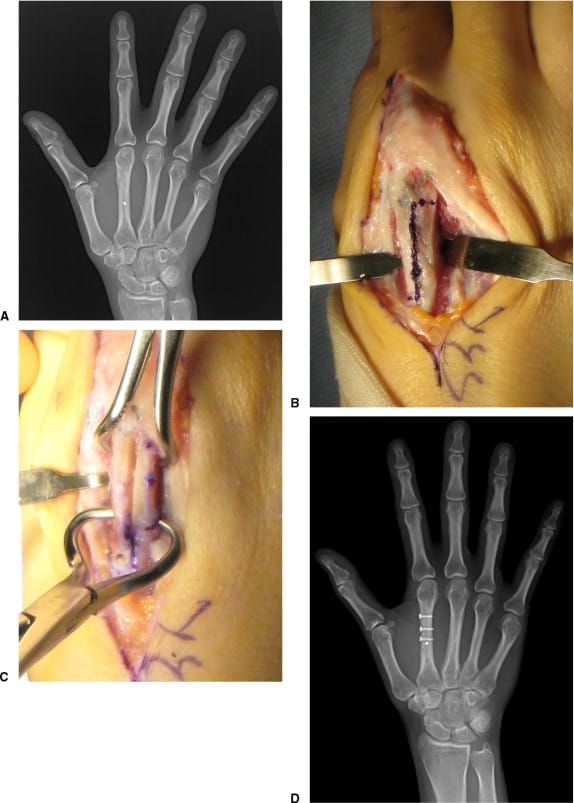
This image shows plate-and-screw fixation of a metacarpal shaft fracture, from the initial radiograph through surgical exposure, plate placement, and postoperative imaging. The low-profile plate provides stability while maintaining the length, alignment, and rotation of the metacarpal.
The key consideration is the relationship between the implant and the extensor tendons. Dorsal plating provides rigid fixation, but prominent hardware, adhesions, and tendon irritation can compromise movement. Careful plate positioning, soft-tissue handling, and early controlled mobilisation are therefore essential to achieving a functional result.
Technique Tip
Plate Fixation of Fifth Metacarpal Neck Fractures
Fifth metacarpal neck fractures, commonly known as boxer's fractures, are frequently managed non-operatively. However, surgical fixation may be indicated in selected cases involving unacceptable rotational deformity, instability, or significant displacement.
This operative video shows open reduction and internal fixation of a fifth metacarpal neck fracture using a low-profile plate with converging distal screws.
What Does the Evidence Say?
Do Fifth Metacarpal Neck Fractures Need Surgery?
Return to work may also favour non-operative care. In the larger multicentre trial, patients treated with bouquet pinning took 42 days of sick leave, compared with 8 days after conservative treatment, although more manual workers had been allocated to the operative group. At one year, there were no significant differences in QuickDASH scores, pain, satisfaction, range of motion, grip strength, or quality of life. The clearest potential benefit of surgery was therefore correction of angulation and hand appearance, rather than improved function.
More recent randomised evidence reached a similar conclusion. Among active adults with 30-70° of palmar angulation, transverse pinning and treatment in an ulnar gutter slab produced comparable union, movement, grip strength, and QuickDASH outcomes, and all patients returned to their previous work and activity. Conservative treatment caused more radiographic malunion and loss of knuckle contour, but this did not impair function; the operative group instead had two superficial pin-site infections.
Key takeaway: Most uncomplicated fifth metacarpal neck fractures do not require fixation. Surgery may improve alignment or cosmesis, but it has not demonstrated a consistent functional or return-to-work advantage. These findings should not be extrapolated to open, malrotated, multiple, or otherwise unstable fractures, which were excluded from the trials.
(Wong, 2017); (Boeckstyns, 2021); (Zawam, 2024); (Sletten, 2015); (Wormald, 2019)
Articles of the Week
3 Interesting Articles with One-Sentence Summaries
Neck fractures may tolerate up to 15° of angulation in the index and middle fingers, 20-40° in the ring finger, and 60° in the little finger, provided there is no rotational deformity, which can cause significant functional impairment.
A systematic review of 26 studies involving 1,014 metacarpal fractures found a 4.6% complication rate following intramedullary screw fixation, with stiffness being the most common complication, and 38% of patients with complications requiring revision surgery.
A meta-analysis comparing intramedullary screws, K-wires, and plating found that intramedullary screw fixation had lower reoperation rates (4% vs 11% for both alternatives), better grip strength, and lower disability scores, with no significant differences in infection rates or final range of motion.
