


In this week's edition
- ✍️ Letter from P'Fella
Operations that start as a bad idea - 🖼️ Image of the Week
Bridging a nerve gap - 🚑 Technique Tip
Digital nerve repair with acellular nerve allograft - 🎧 How I Operate
At the limits of reconstruction with Dr Pedro Cavadas - 📖 What Does the Evidence Say?
Autograft vs allograft - 🔥 Articles of the Week
Nerve transfers, autografts, & processed nerve allografts. - 💕 Feedback
Suggest ideas & give feedback!
A Letter from P'Fella
Operations That Start as a Bad Idea
Recently, I've been looking into these cases more and more. Replant a completely amputated limb or transplant somebody else’s hands.... temporarily attach an amputated part somewhere else on the body to keep it alive. Use a free flap from the opposite leg when the usual reconstructive options have run out.
There’s a strange point in surgical innovation where the difference between impossible and possible is simply that nobody has worked out how to do it reliably yet.
Plastic surgery has always lived quite close to that line. It’s one of the things I love about the specialty. We don’t always have the luxury of choosing from a neat list of operations. Sometimes the defect in front of you doesn’t fit the algorithm, and the operation has to be worked out from first principles.
Of course, the textbooks tend to make innovation look much cleaner than it really is. We see the operation that worked, the paper that was published, and the technique that eventually became accepted. We don’t see nearly as much of the uncertainty beforehand....the failed ideas, anatomical work, the modifications between patient one all the way up to patient twenty. Or the years it can take before something unusual becomes something other surgeons can reproduce.
We’ve been hearing a lot about this while recording How I Operate. Our recent conversation with Pedro Cavadas probably sits at an extreme end of it. We spoke about reconstruction when the usual options have run out, and how he breaks those problems back down into tissue, vessels, timing, and sequence rather than beginning with whether an operation has been done before.
But one thing I’m beginning to appreciate from these conversations is that the surgeons who move the specialty forward don’t necessarily start by trying to do something extraordinary. Usually, they’ve just found a problem they think can be solved better.
And sometimes, a few years later, everyone forgets it was ever considered impossible.
We’ve just recorded another conversation that looks at this from a slightly different angle: not only how new ideas begin, but how we actually investigate them, prove them, and decide whether they deserve to change practice.
More on that one soon!
P’Fella ❤️
Image of the Week
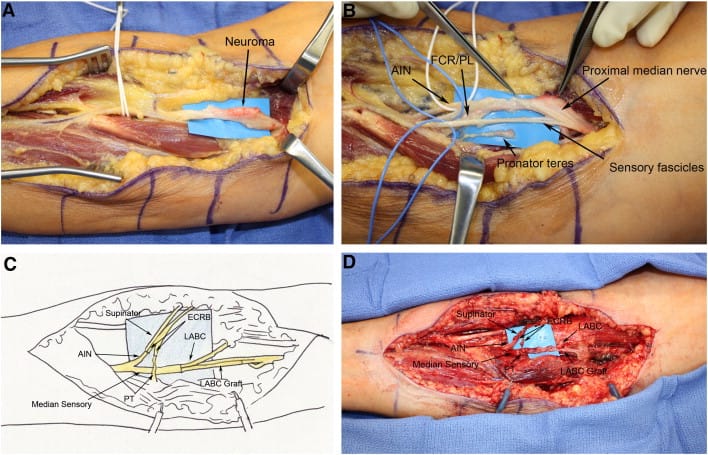
Bridging a Nerve Gap
When a nerve injury leaves a gap that cannot be closed without tension, direct end-to-end repair is no longer appropriate. The damaged ends must first be trimmed back to healthy fascicles, leaving a defect that requires another reconstructive strategy.
This image shows how that decision can extend beyond simply placing a graft. A lateral antebrachial cutaneous nerve graft bridges the sensory component of a proximal median nerve injury, while distal nerve transfers restore motor pathways closer to their targets.
The principle is to match the reconstruction to the function that needs restoring: graft where a viable proximal source can support regeneration, and consider nerve transfer when the distance to the motor target makes regeneration less favourable.
Technique Tip
Digital Nerve Repair with Acellular Nerve Allograft
The central principle of peripheral nerve repair is a tension-free reconstruction. When a nerve gap prevents primary end-to-end repair, reconstruction may require an autograft, nerve conduit, or processed acellular nerve allograft, depending on the characteristics of the defect and clinical context.
In this video, an 8 mm ulnar digital nerve defect is reconstructed using an acellular nerve allograft. The technique demonstrates preparation of the proximal and distal nerve ends, selection of an appropriately sized graft, and microsurgical coaptation at both interfaces to restore continuity without tension.
How I Operate
At the Limits of Reconstruction with Dr Pedro Cavadas
Below is a snippet where Dr Pedro Cavadas challenges one of the classic rules in microsurgery: one artery, two veins.
His argument is simple: when you plan for two veins, you may start accepting small technical mistakes. But when you only have one, you know it has to be perfect. One perfect anastomosis is better than two imperfect ones.
What Does the Evidence Say?
Autograft vs Allograft
The clinical results are encouraging. A 2023 meta-analysis found no significant difference in meaningful sensory or motor recovery between autograft and processed allograft across the nerve gaps examined; both also performed better than conduits for short sensory gaps. Large multicentre allograft series have similarly reported meaningful recovery in roughly 80% or more of repairs, including sensory, mixed, and motor nerves. However, those results need an important qualification: much of the allograft literature consists of uncontrolled observational studies and industry-associated registry data rather than direct randomised comparisons with autograft.
A separate systematic review specifically assessing the quality of this evidence concluded that certainty was very low and that the existing literature could not reliably establish equivalence between processed allograft and autograft. The practical takeaway is therefore not that allograft has replaced autograft. Autograft remains the most established option when reliable regeneration is critical, particularly for larger, mixed, or motor nerve gaps, while processed allograft is a valuable donor-sparing alternative in appropriately selected defects.
(Lans, 2023); (Frostadottir, 2023); (Brooks, 2012); (Safa, 2020)
Articles of the Week
3 Interesting Articles with One-Sentence Summaries
Nerve transfers shorten the distance required for axonal regeneration and typically require only one neurorrhaphy, enabling faster reinnervation of denervated motor targets compared with longer nerve graft pathways.
For digital nerve gaps up to 3 cm, bioabsorbable PGA conduits produced good-to-excellent sensory recovery in 86% of reconstructions, while avoiding the donor-site morbidity of nerve grafting.
Across sensory, mixed, and motor nerve defects measuring 5-50 mm, processed nerve allografts achieved meaningful recovery in 87% of repairs, with no graft-related adverse events reported.
