


In this week's edition
- ✍️ Letter from P'Fella
What makes someone an expert? - 🖼️ Image of the Week
PIA flap pedicle identification - 🚑 Technique Tip
Reverse posterior interosseous artery flap - 🎓 Building in Public
This month at The Plastics Fella - 🎧 How I Operate
New episode coming this Monday! - 📖 What Does the Evidence Say?
Preventing venous congestion in the reverse PIA flap - 🔥 Articles of the Week
Posterior interosseous artery flap: making it more reliable & “reverse” PIA flap - 💕 Feedback
Suggest ideas & give feedback!
A Letter from P'Fella
What Makes Someone an Expert?
You go into them expecting to talk about flap design, anatomy, or techniques. However, you also end up talking about the way experts think. The principles they come back to. The questions they asked decades ago that they're still asking today.
There seems to be a common thread running through all of them.
When we spoke to Professor JP Hong, the conversation wasn't only about the SCIP flap. It was about understanding anatomy well enough to simplify reconstruction and make it more reliable. With Professor Foad Nahai, it wasn't simply how the Mathes and Nahai classification came to life. It was about taking something incredibly complex and turning it into a framework that thousands of surgeons could immediately understand and apply.
Our next episode, releasing on Monday with Professor Claudio Angrigiani, felt remarkably similar. Although he's well known for developing the Posterior Interosseous Artery (PIA) flap, much of our discussion wasn't about the flap itself. It was about the years spent studying anatomy, questioning accepted ideas, and refining a concept until it became dependable enough that another surgeon could reproduce it with confidence.
The ideas that stand the test of time all seem to share a few characteristics. They aren't necessarily the most complicated or the most technically impressive. They're grounded in anatomy. They're logical, reproducible, and most importantly, teachable.
Perhaps that's what expertise really looks like.
Not simply knowing more than everyone else, but being able to organise knowledge in a way that makes other people better surgeons.
The people who shape our specialty don't just contribute new techniques. They create frameworks, refine principles, and simplify complex ideas until they're accessible to everyone else. That's what allows good ideas to spread, evolve, and remain relevant for decades.
If these podcast recordings have taught me anything, it's that the most valuable lessons rarely come from hearing what someone does. They come from understanding why they think the way they do.
P’Fella ❤️
Image of the Week
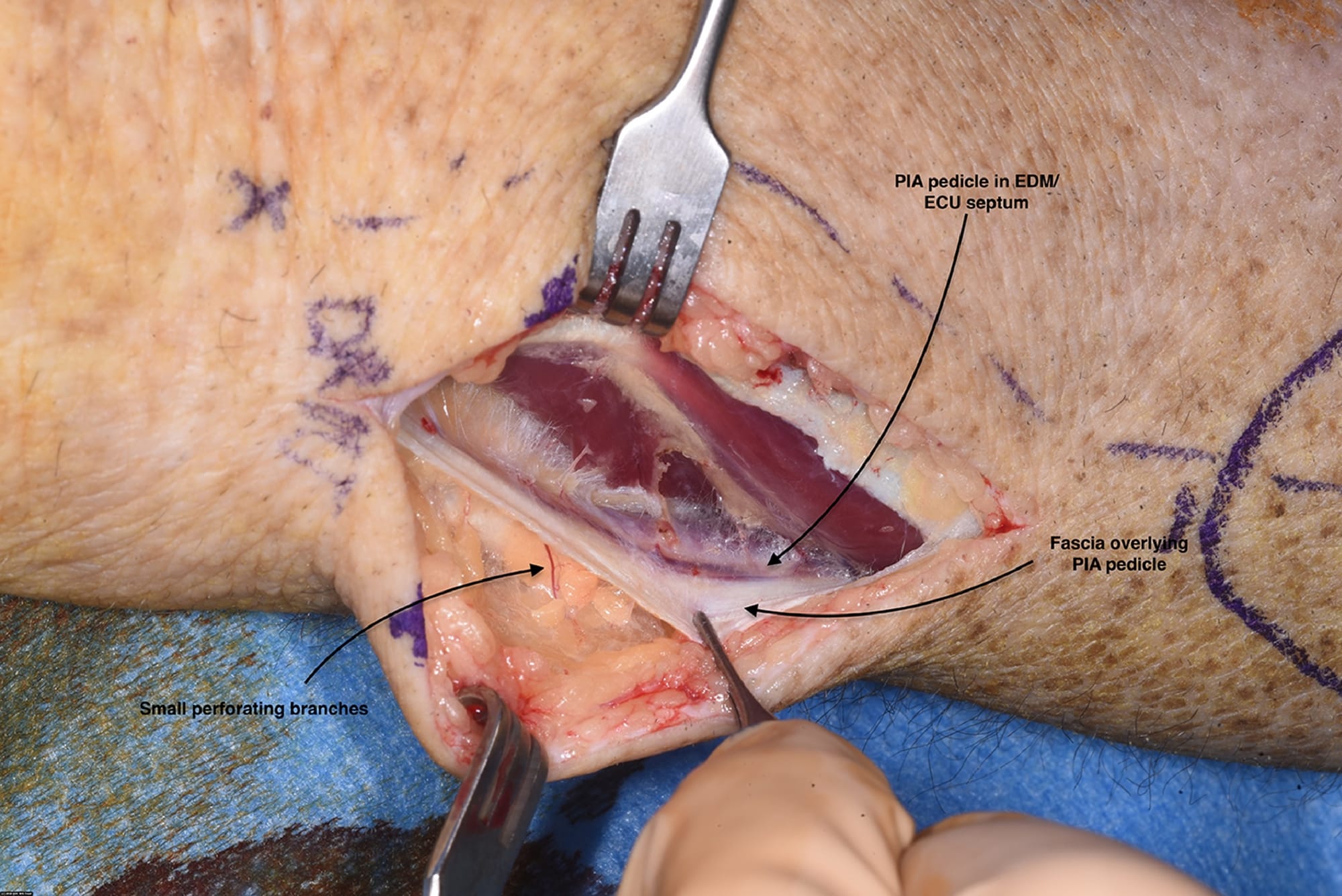
PIA Flap Pedicle Identification
This intraoperative image captures the key step that made the PIA flap reliable: identification of the pedicle within the septum between the extensor digiti minimi (EDM) and extensor carpi ulnaris (ECU).
The septocutaneous plane consistently contains the posterior interosseous artery and its perforators. Here, the fascia is opened to expose the pedicle, with small perforating branches visible. This anatomical basis allows safe flap elevation without sacrificing a major vessel to the hand.
Technique Tip
Reverse Posterior Interosseous Artery Flap
The reverse PIA flap is a reliable option for reconstructing dorsal hand and first web space defects while preserving the radial and ulnar arteries. Successful harvest depends on identifying the posterior interosseous artery within the septum between the ECU and EDM, preserving the posterior interosseous nerve, and maintaining the distal pivot point approximately 2 cm proximal to the distal radioulnar joint.
This operative video demonstrates flap design, septal dissection, pedicle elevation, and safe transfer of the reverse PIA flap.
Building in Public
This Month at The Plastics Fella
We're also looking to plan a webinar series, with the first session expected later this year. We're excited for more of these conversations with the team because they shape the platform and ensure we're building in a direction that's truly useful for the community.
How I Operate
New Episode Coming This Monday!
In this episode, we sit down with Professor Claudio Angrigiani to discuss the anatomy, design, and surgical thinking behind one of the most important local flaps for hand and wrist reconstruction.
From cadaveric studies in Argentina to 40 years of clinical experience, Professor Angrigiani reflects on how the PIA flap was developed, why its middle perforators matter, and where surgeons commonly get into trouble when raising it.
Designing the Perfect PIA Flap, with Prof. Claudio Angrigiani: Out this Monday.
What Does the Evidence Say?
Preventing Venous Congestion in the Reverse PIA Flap
Technical studies suggest that reliability depends less on simply including more tissue and more on preserving an effective venous pathway. In smaller flaps, including a single well-positioned perforator was associated with less venous congestion than incorporating several perforators, possibly because excessive pedicle dissection, twisting, or compression can impair outflow. Other clinical series have reported low congestion rates when the flap is raised with a generous cuff of fascia and subcutaneous tissue, avoiding skeletonisation of the pedicle and preserving communicating veins. Where congestion risk is particularly high, adding a superficial venous anastomosis, or “superdrainage,” has also been used successfully to provide an additional route for venous return.
The practical lesson is that a reverse PIA flap should not be judged by arterial inflow alone. A broad, untwisted pedicle, preservation of the surrounding fascia and venous communications, a tension-free tunnel, and selective venous superdrainage may be more important than maximising the number of included perforators. Persistent postoperative congestion should be treated as a mechanical outflow problem until proven otherwise.
(Reyad, 2016); (Sönmez, 2018); (Puri, 2007); (Acharya, 2014); (Kelada, 2013)
Articles of the Week
3 Interesting Articles with One-Sentence Summaries
The posterior interosseous artery flap provides thin, well-vascularised dorsal hand coverage without sacrificing a major artery, with reliable reach based on distal interosseous anastomoses and primary donor closure possible if kept under 3-4 cm in width.
Adding simple intraoperative modifications such as venous supercharging, converting to a free flap, or widening the pedicle can prevent necrosis and significantly improve the safety of posterior interosseous flaps in difficult anatomy or compromised limbs.
Anatomical and clinical evidence suggest the reverse PIA flap is actually supplied by direct flow via the recurrent anterior interosseous system, with safe design limited to the distal forearm and proximal extensions risking flap loss.
