


In this week's edition
- ✍️ Letter from P'Fella
Pushing the limits of microsurgery - 🎓 Building in Public
Weekly updates and behind-the-scenes on Instagram - 🖼️ Image of the Week
AV loops in limb reconstruction - 🚑 Technique Tip
Chimeric ALT musculocutaneous free flap - 🎧 How I Operate
Episode 1 is out now! - 📖 What Does the Evidence Say?
Double venous anastomosis in free flaps - 🔥 Articles of the Week
MSAP flap, one-stage limb reconstruction, & AV loops - 💕 Feedback
Suggest ideas & give feedback!
A Letter from P'Fella
Pushing The Limits of Microsurgery
Not just people who can do difficult cases, because there are plenty of technically excellent surgeons. I mean the ones who seem to keep moving the boundary of what microsurgery can actually do.
The ones who look at a case most people would file under “too difficult”, “too damaged”, or “not sensible”, and instead of reacting emotionally, they just start breaking the problem down properly. Tissue. Vessels. Timing. Sequence. Function. What is the real limitation here? And which part of it can actually be changed?
I find this super interesting. It doesn’t feel like bravado when you hear them speak. In fact, it’s usually the opposite. They sound calmer than everyone else. Less dramatic. More stripped back. The deeper you go into their thinking, the more it comes back to the same things: anatomy, planning, repetition, respect for blood supply, and a willingness to stay with a problem longer than most people would. A lot of the time, what looks extreme from the outside is actually just first-principles thinking taken very seriously.
The conversations I have during our podcast recordings have been eye-opening for me. We recently released our episode with JP Hong, and what stayed with me afterwards was not just the SCIP flap itself, but the mindset of experts who shaped these techniques. The refinement and the discipline. The way a good idea gets made dependable.
I'm also halfway through recording with another microsurgery expert, Pedro Cadavas, and it’s been fascinating. Once you get past the surface in these conversations, what’s underneath is a very clear internal logic about what is possible, what is sensible, and what should be left alone.
That is the part worth studying. Not just the operation, but the way of thinking that follows it. Because if microsurgery is going to keep moving forward, it probably won’t happen through noise or theatrics. It’ll come from a small number of people who understand the fundamentals so well that they know exactly when they can be stretched.
If you haven’t listened to our podcast episode with JP Hong yet, check it out on your preferred platform!
And if there’s something specific you’d like us to ask Pedro Cavadas while we’re still recording, send it over. We’d love to hear it.
P’Fella ❤️
Building in Public
Weekly Updates and Behind-the-Scenes on Instagram
But I’ve finally given in.
To see the more informal side of things like bits from the podcast, weekly updates, and some behind-the-scenes stuff from what we’re building at the P'Fella, you can find me here.
Image of the Week
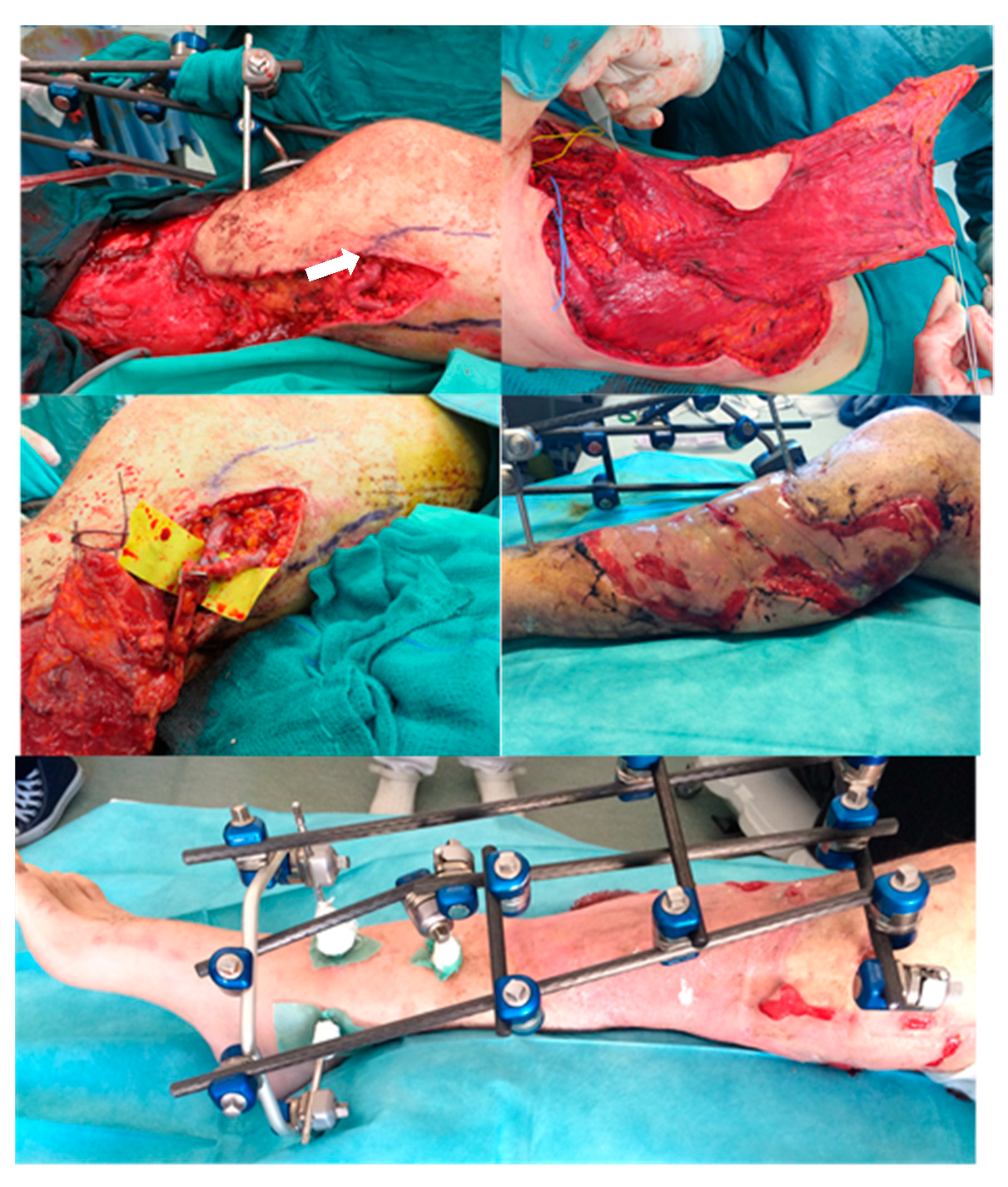
AV Loops in Limb Reconstruction
This week's image features the use of an arteriovenous (AV) loop; A strategy used when local recipient vessels are unavailable or unsuitable.
In complex limb trauma, vessel injury, scarring, or prior surgery can leave no reliable targets for microsurgical anastomosis. Here, a vein graft is used to create a temporary artery-to-vein loop, establishing a new vascular conduit outside the zone of injury. This loop can then be divided and used as recipient vessels for free tissue transfer, either immediately or in a staged approach.
👉 When recipient vessels don’t exist, create them.
Technique Tip
Chimeric ALT Musculocutaneous Free Flap
Complex defects often require more than skin alone. The chimeric anterolateral thigh (ALT) flap combines separate skin and muscle components supplied by branches of the same vascular pedicle, allowing each tissue element to be positioned independently. This makes it particularly valuable for three-dimensional reconstruction of composite head and neck, lower limb, and traumatic defects.
This video demonstrates harvest of a chimeric ALT musculocutaneous flap, highlighting perforator identification, intramuscular dissection, preservation of independent tissue components, and flap elevation.
How I Operate
Episode 1 Is Out Now!
In this episode, we are joined by Professor JP Hong for a deep dive into the SCIP flap: from its evolution as a modification of the groin flap to the anatomical principles, technical refinements, and decision-making that helped make it a reconstructive workhorse.
We discuss perforator anatomy, flap reliability, ultrasound planning, when to use the SCIP flap, when not to use it, and how small, deliberate refinements can change the way an operation is taught and performed.
What Does the Evidence Say?
Double Venous Anastomosis in Free Flaps
That said, the benefit is not universal in every setting. Systematic reviews support dual venous drainage as a general protective strategy, particularly in head and neck reconstruction, but lower-extremity evidence is more mixed and does not show the same clear reduction in complications across all studies. A second vein is best understood as a way to improve reliability when it is technically feasible and meaningfully adds drainage, rather than as a rule for every flap.
The takeaway is not that simply “two is always better.” It is that venous compromise remains one of the main reasons free flaps fail, and building robust outflow at the first operation is often easier than trying to salvage congestion later.
(Sánchez-Moreno, 2026); (Christianto, 2018); (Kim, 2021); (Matthews, 2017); (Riot, 2015)
Articles of the Week
3 Interesting Articles with One-Sentence Summaries
The medial sural artery perforator flap provides a thin, pliable tissue option with a long, reliable pedicle and minimal donor site morbidity, but requires meticulous intramuscular dissection and precise perforator selection to succeed consistently.
One-stage vascularised bone and soft tissue reconstruction can achieve high union rates and reliable limb salvage in complex lower extremity trauma, reducing the need for staged procedures when meticulous debridement and appropriate flap selection are performed.
Arteriovenous loops enable free flap reconstruction in vessel-depleted extremities with high success rates, with one-stage loops showing lower thrombosis risk than delayed two-stage approaches.
